
 Turn KPIs into a game – and watch performance jump
KPI Gamification is the use of game design elements – points, badges, leaderboards, challenges – to make Key Performance Indicators more engaging and motivating. Not magic; behavioral mechanics applied to operational data the company already has.
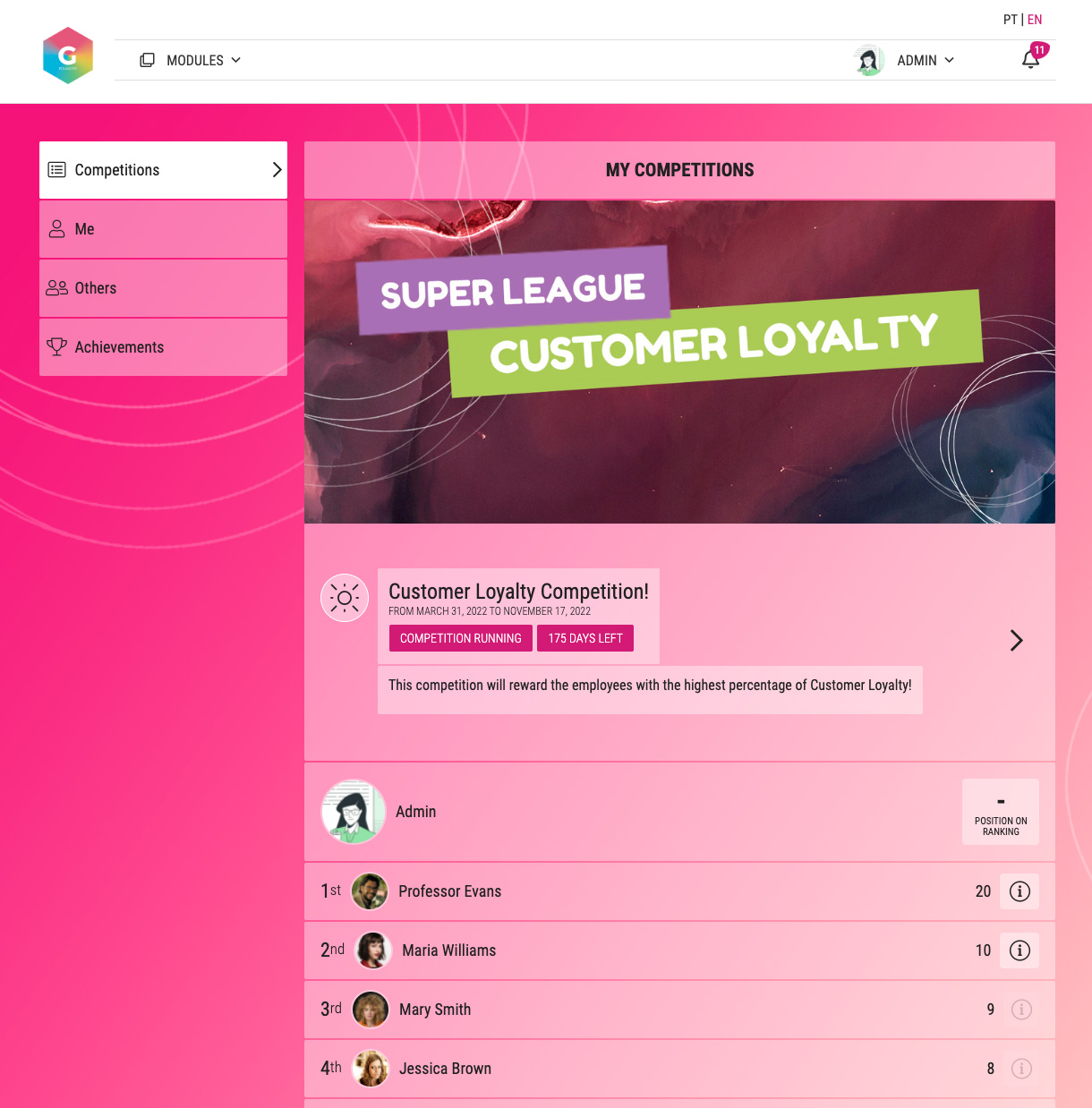
With the Competitions Module, you create competitions from your own data – sales, calls, deliveries, support tickets – and turn aligned, motivated and resilient teams into the norm. Data flows in via XLS file or external API integration with any platform (CRM, ERP, BI).What is Gamification – and why it works on KPIs
Gamification is the introduction of game elements (medals, points, rewards, rankings) into non-game contexts. Forbes: gamification increases employee engagement – and beyond a more dynamic environment, it improves interaction between employees, productivity and retention.
Applied to KPIs, the engine works because:
Real-time visibility
Each employee sees their progress live – no need to wait for a monthly meeting to know where they stand.
Healthy social pressure
Public leaderboards (individual or team) create constant peer recognition. More motivating than abstract targets.
Tangible rewards
Medals and virtual coins exchangeable in the Marketplace. The effort has a concrete payoff – not just a metric on a slide.
Learn more about the GFoundry Gamification Engine.
6 use cases by sector
KPI Gamification applies to virtually any sector with measurable data. 6 real-world cases:
Sales teams
Monthly competitions on sales volume, contacts made, contracts signed. Medals and rewards for the top performers.
Call Centers
Individual or team competitions by contacts made and effectiveness. Organize as teams that aggregate individual scores.
Transport & logistics
Minimize delivery incidents. Inverted ranking (least incidents wins). Real case: DPD Portugal – see below.
Technical teams (support)
Competitions on troubleshooting volume and speed. Recognize the fastest, most effective fixers.
New software adoption
Set adoption targets per team in the new ERP/CRM. Recognize teams that adopt fastest. More info.
Onboarding completion
Gamify completion of mandatory onboarding modules. Compete by checkpoints reached. Higher onboarding completion = faster ramp-up.
Real Case: DPD Portugal
DPD Portugal implemented “Post-a-Goal” – a KPI competition for drivers focused on reducing delivery incidents and increasing performance.
Operational challenge
Driver fleet across Portugal with operational KPIs (deliveries per day, incident rate, customer satisfaction). Hard to standardize motivation across distributed teams.
Gamified competition
Operational data fed via API from operations system to GFoundry. Public rankings per region, medals for top performers, monthly recognition.
More motivated drivers
Performance increase. Decrease in operational incidents. Drivers more engaged with corporate goals.
Mobile-first
Drivers are deskless – the platform needs to work on a phone. GFoundry’s native app made adoption fast.
4 best practices to make it work
KPI Gamification doesn’t work “because of gamification”. It works when designed properly. 4 rules tested in dozens of implementations:
Pick KPIs the team controls
Gamifying a KPI the team can’t influence directly (e.g. exchange rates) generates frustration. Pick metrics with direct cause-effect.
Balance individual vs team
Only individual = unhealthy competition. Only team = free-riders. Mix the two scopes – and reward both behaviors.
Short, repeated cycles
Monthly or quarterly competitions beat annual ones. Frequent winners; energy doesn’t fade after week 2.
Strong narrative
Don’t call it “Q4 Sales Competition”. Give it a name, theme, story. Engagement multiplies when there’s narrative.