

A company wants to prepare its next team managers. It runs a questionnaire, gathers feedback and receives a report with results for each competency. The information looks complete. But what, exactly, does a score of “4 in communication” mean? Does the person explain a decision clearly? Listen to an objection? Give feedback when the other person reacts badly?
A competency assessment becomes useful when it connects a question about work with evidence that can help answer it. This requires appropriate methods, explicit criteria and a clear understanding of how far each result allows us to go. Programme design starts here, before choosing a platform or a battery of tests.
In this article, we follow a fictional example of manager development to explain how to build that connection, what research supports and how to continue the work after an assessment using a platform such as GFoundry.
What is a competency assessment?
It is a structured process for gathering and interpreting evidence about competencies relevant to a particular purpose. It can help identify development needs, prepare for a change of role or support a selection decision. The same activity can be useful for one purpose and insufficient for another.
For example, a self-perception questionnaire can be a useful starting point for a development conversation. To decide who should take on a role, we need to ask what other evidence supports that use. The conclusion we seek must be proportionate to the quality and breadth of the information gathered.
It is also helpful to distinguish an assessment programme from an assessment centre. The International Taskforce on Assessment Center Guidelines describes the latter as a method with several components, including behavioural simulations and multiple assessors trained to observe and evaluate. A set of online questionnaires alone does not meet that definition.
What about performance evaluation? In talent management, a performance cycle follows contributions and objectives over a period of time. An assessment programme can explore competencies or role requirements through specific activities. The two processes can share information, but the result of an exercise does not automatically replace an understanding of the work done throughout the year.
Start with the work that needs to be done
In our fictional example, the organisation wants to help new customer service managers hold conversations with their teams. “Assess leadership” would be too broad an intention to guide the programme. The question is more specific: how does the person identify a performance problem, discuss it with an employee and agree a next step?
This situation makes it possible to define observable behaviours. “Has leadership presence” depends heavily on an assessor’s impression. “Describes the problem with examples, asks questions before reaching a conclusion and confirms a commitment” allows more specific evidence to be gathered.
The following table offers illustrative criteria for a simulated conversation. It is neither a validated scale nor a universal leadership rating; it shows the level of precision that the design can aim for.
| Dimension | Evidence to look for | Question to explore |
|---|---|---|
| Clarity | Explains the situation with specific examples and distinguishes observations from interpretations. | Does the other person understand the problem and its impact on the work? |
| Listening | Asks questions, explores the other person’s perspective and checks their understanding. | Does the employee’s response change or deepen the initial interpretation? |
| Agreement and follow-up | Defines an action, an owner and a review point. | Do both people know what will happen after the conversation? |
These criteria need examples for different levels of execution and should be tried out before launch. If two assessors interpret the same behaviour very differently, the criteria and their application need discussion. A five-point scale does not resolve that difference on its own.
Choosing methods: what evidence does each add?
The number of instruments is not a sufficient measure of the quality of a competency assessment. The question is what each method allows us to understand and why it is worth combining it with the others.
| Method | What it can add | How to interpret the result |
|---|---|---|
| Self-assessment | The person’s own view of their behaviours, difficulties and priorities. | It is a self-perception; examples and other perspectives are needed to explore it further. |
| 360° feedback | The experience of people who work with the participant in different relationships. | It depends on who responded, their contact with the person and the situations they observed. |
| Structured interview | Examples of situations, decisions and actions, explored through common questions and criteria. | A convincing account needs further exploration: what did the person do, under what conditions and with what result? |
| Practical case or simulation | Behaviour demonstrated in a task or situation designed for the programme. | It shows execution in that context; the relevance of the task and the conditions of completion need checking. |
| Psychometric test | Information about the specific construct the instrument was developed to measure. | Interpretation should follow the manual, the reference population and the validity evidence for the intended use. |
In the manager development programme, self-assessment can identify conversations the person tends to postpone. Team feedback helps establish how that difficulty is experienced at work. A simulation allows observation of how the person responds to an objection. An interview explores a real situation in more depth. These are different contributions to a common question.
A psychometric test can be part of the journey when it addresses an identified need. It is sensible to choose what we want to understand first, then select an appropriate instrument, with support from qualified professionals when the test requires it. The availability of a test on a platform does not, on its own, demonstrate its suitability for that programme.
Validity and reliability: what makes a result credible?
Reliability concerns consistency of measurement. Does a result change because the competency changed, because the task was different or because another assessor applied the scale differently? Validity concerns the evidence supporting the interpretation and use of results. Even a consistent measurement can be unsuitable for the conclusion we want to draw.
Consider a manager who scores well on a knowledge test about feedback. This shows knowledge of the expected answers. To conclude that the person can conduct a difficult conversation, we also need to observe application. Explaining a technique, using it in a simulation and applying it at work are related forms of evidence with different meanings.
Recent evidence: context changes what we can conclude
A meta-analysis by Demeke and colleagues, published in August 2026, integrated contemporary evidence on general mental ability and job performance. The full dataset included 212 samples and 109,396 participants. Across the different analyses, mean operational validity ranged from 0.18 to 0.22; the authors propose 0.20 as a summary estimate of that relationship in contemporary data.
These values are correlation coefficients, not accuracy percentages. The study concerns the relationship between general mental ability and job performance; it does not evaluate every psychometric test or demonstrate that a particular development programme produces results. The practical implication is to ask for current evidence relevant to the instrument, population and purpose, rather than accept a generic promise to “predict talent”.
When choosing a solution, it is worth asking specific questions: what does each instrument measure? In which population was it studied? What evidence supports the proposed use? How are assessors prepared? What influence might language, the digital format or access conditions have? A pilot can identify problems with understanding and execution before the whole population takes part.
When results do not agree
Let us return to our team manager. In the self-assessment, the person believes they give clear feedback. In the simulation, they describe the problem precisely. Yet some team members report that conversations happen late, after the situation has already become worse.
There is no need to choose one source immediately as “the truth”. The person may know how to conduct the conversation and still avoid it in everyday work. There may also be differences between shifts, limited time or a team experience that the exercise did not reproduce. The divergence helps form a hypothesis: perhaps the main challenge lies in the timing and regularity of conversations.
The feedback discussion can explore that hypothesis through recent examples. The programme can then offer an opportunity to apply the learning and gather further evidence. The aim is to improve the explanation and the action, rather than produce an average that conceals the difference.
The same care applies to scales. A rating of 4 out of 5, the 70th percentile and a 100% completion rate are not equivalent measures. Putting them on the same visual scale does not make them comparable. Before aggregating results, we need to define what each measure represents and justify the combination. A missing assessor response should remain visible as missing information, rather than be turned into a low rating of the person.
Participation is also part of evidence quality
A programme can have sound instruments and still reach the feedback discussion with incomplete information. If responses from a relevant part of the team are missing, the interpretation may be concentrated on the experience of the manager or a single group. It matters who had an opportunity to observe the behaviour and which perspectives are still unrepresented.
This creates an operational responsibility: explain the programme’s purpose, provide clear instructions, organise deadlines and track outstanding actions. Reminders should help people complete activities by showing what remains and where to act. Participation rates deserve attention, but completing the journey does not, on its own, demonstrate a competency.
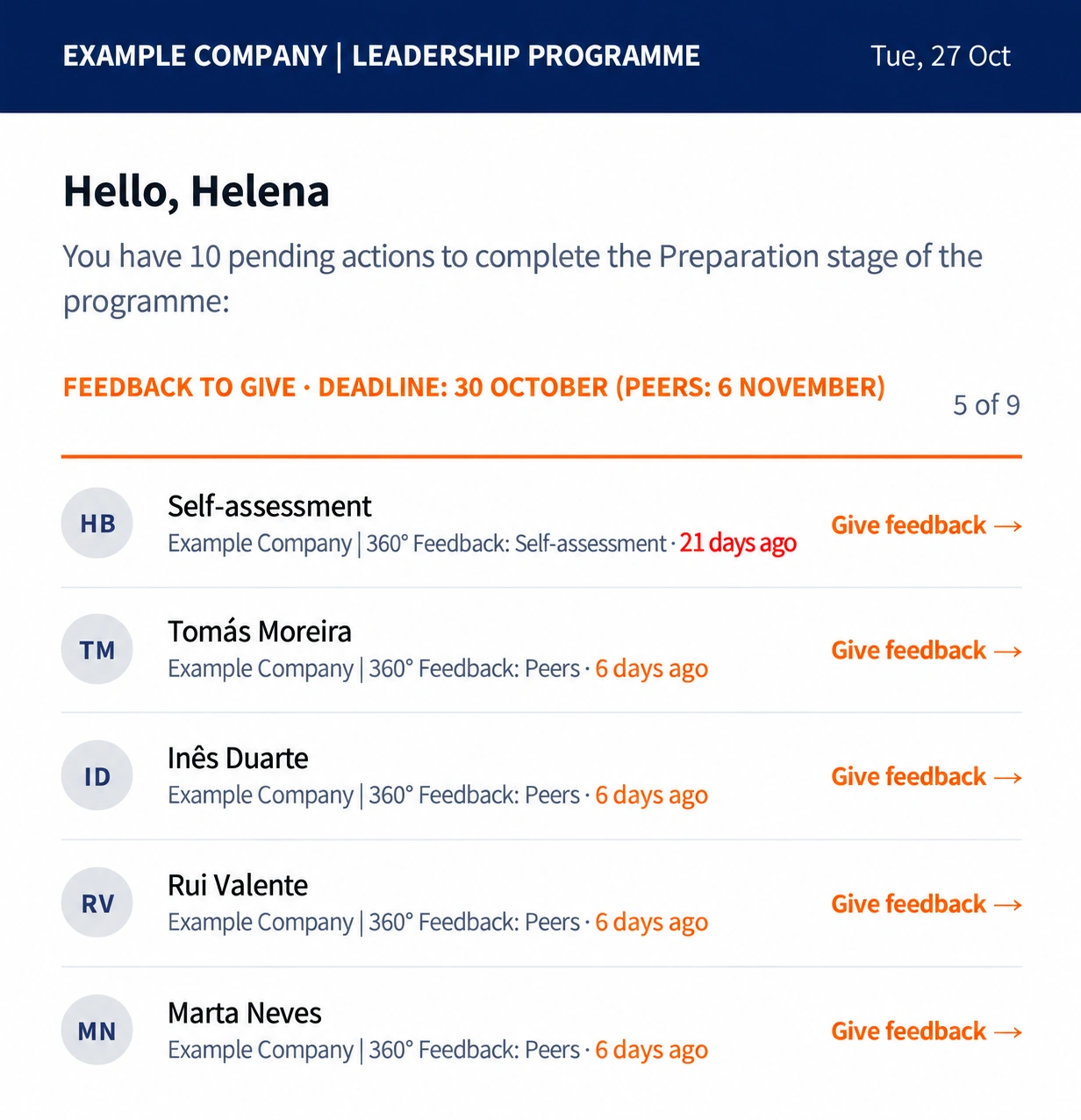
Example follow-up email for a programme in GFoundry. The company and the people are fictional. Open the image to view the details.
From feedback to change at work
Receiving feedback does not guarantee a change in behaviour. In a meta-analysis of 24 longitudinal studies, published in 2005, Smither, London and Reilly found generally small improvements over time in ratings by managers, peers and direct reports following multisource feedback. The authors discuss conditions that can support improvement, including recognising a need to change, believing change is possible, setting goals and taking action.
This is a reference on multisource feedback, rather than an evaluation of all forms of assessment. Nevertheless, it helps place a practical question at the centre of the design: what will happen to the results after they have been discussed?
In our example, the agreed priority could be to hold feedback conversations earlier. The plan can combine a short learning activity on preparing the conversation, a rehearsal, a real opportunity to apply it and a review with the manager. At the review, the focus is what happened: did the conversation take place earlier? Was there a clear agreement? What remains difficult? These questions allow the support to be adjusted.
To evaluate the programme, distinguish three areas: execution, such as participation and meeting deadlines; evidence quality, such as competency coverage and consistency between assessors; and development, such as behaviours observed in new work situations. Improvements after the programme deserve analysis, but do not automatically demonstrate that the assessment caused them.
How GFoundry can support a competency assessment
The Feedback module plays a central role in gathering evidence for the programme. It supports configurable questionnaires with open-ended questions, rating scales and response options, organised into feedback scopes. These can include self-assessment and feedback between colleagues and between employees and managers, according to the permissions defined. GFoundry’s Feedback solution allows this evidence gathering to be part of formal assessment activities while keeping feedback exchanges available at work.
In the manager development example in this article, the questionnaire could ask the participant to describe how they prepare a difficult conversation, and colleagues to give examples of how the person listens, explains the problem and follows up on commitments. The programme therefore gathers specific perspectives to discuss in the debrief and consider alongside what was observed in the simulation.
The programme team can track pending requests, responses in progress and completed feedback, review the answers and export the information for analysis. After the assessment, Feedback allows people to continue requesting and sharing observations about new work situations. For example, after a team conversation, the manager can request feedback on clarity and listening, then review development priorities in light of what happened.
The organisation and specialist partners can define the methodology, instruments and interpretation. The programme can combine activities in GFoundry with access to external psychometric testing platforms; completion tracking and the exchange of results depend on the integrations available in each project.
In Skills Management, the competency catalogue helps establish a common language. The documentation explains how tags connect competencies to information from Learn, Recognition and Evaluation. This connection depends on configuration: learning activity, recognition and an evaluation rating retain different meanings.
The Role-Play Coach can add conversation practice with an AI interlocutor and feedback against the scenario’s criteria. It is useful for rehearsing and discussing a performance. Session feedback is generated by AI and should be reviewed as information about that practice. It is not a personality test or automatic validation for promotion decisions. Role-play evidence is kept separately and does not appear in the Skills Mapping heatmap.
When the programme includes evaluation and careers, development plans and Touchpoints support reviews of objectives and actions with the manager. Talent Insights adds context to the profile, such as the latest evaluation and the status of plans and training, respecting the sources and access permissions. Performance and potential evaluation, People Intelligence and Talent Insights are available on the Premium plan.
For the fictional programme in this article, this makes it possible to organise activities, track missing responses, prepare the feedback discussion and continue working on priorities through learning, practice and follow-up. Technology helps execute the methodological design and maintain that continuity.
Explore GFoundry’s solution for assessment programmes.
Before launching your next programme
Ask the team responsible to explain a complete sequence: the work situation that matters, the behaviour to observe, the evidence each method gathers, the interpretation it supports and the action that could follow the feedback discussion. If one of these connections remains unexplained, it is worth revisiting the design before launch.
A good competency assessment gives people a more precise understanding of what they can do, what they need to develop and how they can work on it. Programme quality is reflected in the clarity of that connection and the follow-up that makes it useful at work.
Sources and documentation
- Demeke, S., Sackett, P. R., Nye, C. D., Li, Y. and Kuncel, N. R. (2026). Is general mental ability still the best predictor of job performance? Integrating contemporary meta-analytic evidence. Journal of Business and Psychology. Source of the data on general mental ability and job performance.
- Smither, J. W., London, M. and Reilly, R. R. (2005). Does performance improve following multisource feedback? Personnel Psychology, 58(1), 33–66. Source of the synthesis of 24 longitudinal studies.
- International Taskforce on Assessment Center Guidelines (2015). Guidelines and Ethical Considerations for Assessment Center Operations. Journal of Management, 41(4), 1244–1273. Reference for the assessment centre method.
- GFoundry Help Center: Feedback scopes, Feedback questionnaires, reviewing and exporting feedback answers, Skills Mapping, Role-Play Coach, Touchpoints and Talent Insights. Documentation for the features discussed.