
Knowledge transfer becomes urgent when someone announces their departure, changes role or stops overseeing an operation. At that point, the team usually knows where the files are. What it cannot always recover is the reasoning behind a decision, the exception that changes a procedure or the signal that it is time to ask for help.
For HR, L&D and managers, the useful question is specific: who will be able to carry out the critical work after the transition, with what support and with what evidence? This guide proposes a five-step model, a reusable handover record and a fictional example to organise that response without trying to document everything a person has learnt.
APQC describes knowledge continuity as the ability to keep critical knowledge available and usable during departures and role changes. The objective includes its use by other people, as well as the preservation of records. That principle guides the model presented here.
What is lost when knowledge depends on one person
Some aspects of work are easy to describe: the fields in a form, the approval sequence, the location of a document. Other aspects have developed through experience. They include recognising an unusual situation, understanding when a rule no longer applies or knowing who can clarify a dependency between teams.
Consider someone who prepares a monthly report. The file may contain every formula and still leave questions unanswered: which data source takes precedence when there are discrepancies? Which changes warrant investigation? Who approves a correction before the report is circulated? A successor may repeat the clicks without being able to make these decisions.
An exit conversation focused on the employee’s experience also serves a different purpose from a knowledge-transfer session. Both can be useful, but the latter needs to explore the actual work, examine examples and leave a traceable record of decisions.
NASA’s knowledge continuity guide for supervisors recommends integrating sharing into everyday work and preparing the transition as soon as it becomes known. The document combines role documentation, shadowing, interviews and continuity materials. In practice, the combination should depend on what needs to be learnt and the time available.
Before documenting, choose the work that must continue
Start with tasks whose interruption would have concrete consequences. A list of responsibilities such as “support customers” or “manage training” is too broad. “Handle an urgent request that arrives without the required information” or “reconcile attendance before closing a training session” makes it possible to identify decisions, resources and completion criteria.
The manager and the person preparing to move on can work through four questions:
- Impact: what happens if this task fails or stops?
- Dependency: how many people can carry it out today without direct support?
- Next occurrence: when will it need to be done again?
- Recovery: how much effort would it take to reconstruct the missing knowledge?
These questions help establish priorities; they are not a scientific risk scale. An annual activity may warrant attention before a daily task if it depends on a single person and the opportunity to observe it is about to disappear. Record the tasks that are no longer necessary too: a role change can provide an opportunity to simplify the process, with an explicit decision by the person responsible for it.
Knowledge transfer in 5 steps
The following model is a practical proposal for organising the transition. The sequence is critical task → exceptions → documentation → recipient → execution test. Identify who could receive the knowledge at the initial meeting, then use the five steps to check whether the transfer is complete.
1. Define the critical task and the expected result
Describe where the work starts and ends. What triggers it? What information needs to be available? What is an acceptable result? Add the limits of decision-making authority and the conditions that require the task to stop or approval to be sought.
“Prepare the monthly close” is still too vague. “Produce the version of the report that the manager can approve, with discrepancies identified and sources recorded” makes it possible to discuss quality. The person taking over knows what to deliver, and the person supporting them knows what to observe.
2. Make exceptions and reasoning visible
Ask for a routine example and a case that required judgement. Rather than asking only “how do you do it?”, ask “what led you to choose this option?”, “which signal indicated a problem?” and “under what circumstances would you have chosen another approach?”.
Record the relevant exceptions, the signals that distinguish them and the limits of the person’s autonomy. Separate current rules from temporary solutions. A workaround used in an emergency should not become an approved practice in the procedure without review by the person responsible.
3. Produce documentation people can use
Choose the format to suit the task. A short procedure can explain a stable sequence. An annotated example shows a decision. A brief video can help someone observe a movement or navigation sequence. A contact list organised by role clarifies dependencies without exposing unnecessary personal information.
The handover record should point to the official version of the materials, identify who maintains them and record the date of the last review. Avoid creating multiple copies without a main reference. If you record a demonstration, check internal recording rules and remove personal or confidential data that is not needed for learning.
Document how to request the necessary access. Do not include passwords, authentication codes or access keys in guides and recordings. Permissions should be granted by the responsible people through the organisation’s approved channels.
4. Confirm the recipient and the conditions for learning
Each priority task needs a named person to receive it. “The team will be responsible” leaves open who learns, who decides and who takes on the work on day one. Where the task warrants it, define a backup person and a contact for situations beyond the agreed level of autonomy.
Check prior knowledge, access and available time. The manager should make room for observation, practice and questions by adjusting workloads. If there is no successor yet, appoint an interim owner for the documentation and continuity of the work. A future hire does not resolve the gap between departure and arrival.
5. Test execution and record what is missing
Ask the recipient to work through a representative case using the materials prepared. The experienced person observes and intervenes when the risk requires it. Where possible, include an exception or a decision-making question to see whether the person recognises the limits of the procedure.
The test should be proportionate to the risk: a simulation with fictional data may suit an administrative process; an activity with safety implications requires qualified supervision and the organisation’s own criteria. A simulation does not replace mandatory qualifications or authorisations.
Record the outcome, questions and necessary changes. If execution depended on instructions that were missing from the materials, add that context and check the gap again. A quiz or reading confirmation can support learning, but a decision about autonomy needs evidence suited to the work.
A simple record to track the transfer
Use one record per priority task. The format below can be adapted to a document, a work tool or a learning path the team already uses.
| Field | What to record |
|---|---|
| Task and result | When it starts, what should be completed and how quality is checked. |
| Exceptions and limits | Warning signs, common decisions and situations that require support or approval. |
| Supporting materials | A link to the official version, an annotated example and instructions for obtaining access. |
| People and deadline | Who transfers, who receives, who validates and when the task will be needed again. |
| Execution test | The case used, criteria observed, outcome and points requiring further practice. |
| Continuity | The person responsible for updates, the review date and unresolved risks. |
A status such as “documented”, “in practice”, “validated” or “with gaps” is more informative than a single completion field. Define what each status means with the team. Validation should identify who performed it and the evidence on which it was based.
Fictional example: changing role without leaving a routine dependent on one person
Illustrative scenario, unrelated to any client: in a fictional company, a training coordinator is about to change role. One of her activities is closing each training session, which requires cross-checking attendance, results and information from the trainer. The colleague taking over the routine knows the tool but has never handled a discrepancy between sources.
The manager chooses this task as a priority because a session needs to be closed soon and only the coordinator understands the exceptions. The two colleagues work through a completed example, explain the source of each data point and record the procedure. They add a case with a missing attendance record and identify who has the authority to confirm it.
In the first simulated attempt, the recipient prepares the record but treats an empty cell as an absence. Observation reveals a rule that had been implicit: missing information requires clarification before closure. The handover record is corrected to include this distinction and the responsible contact.
In a second attempt, the recipient recognises the discrepancy, follows the agreed escalation route and explains why the record cannot yet be closed. The manager records the evidence and arranges support for the first real case. The intended result of this handover is the ability to execute the task and recognise one’s own limits, without relying on informal messages to the person who changed role.
Who does what, including when time is short
The manager sets priorities, makes time available, identifies who will take over the work and decides how to handle remaining risks. The person transferring the knowledge explains the practice and helps make exceptions visible. The recipient tests the materials and raises questions. HR coordinates the stages of the transition and responsibilities; L&D can help design the activities and learning criteria. System or process owners handle access and approvals within their remit.
When only a few days remain, reduce the scope according to risk. Choose the tasks that will occur first or whose failure would have the greatest impact, gather existing materials, identify support contacts and carry out at least one practical check where possible. Explicitly record what has not been transferred. The manager may need to redistribute work, increase supervision or postpone an activity.
If the person has already left, reconstruct the information from authorised sources, colleagues and work examples. Identify what is confirmed and what remains a hypothesis. Do not treat a former employee’s informal availability as a permanent dependency of the process.
For internal moves, also agree a date for the transfer of responsibility. Without that boundary, the person may continue performing the previous role while taking on the new one. Temporary support should have an agreed scope and availability.
How GFoundry can support learning during this transition
Building an internal academy can give these materials a further use after the initial handover, provided someone is responsible for keeping them up to date. A record used in one transition can then become a resource for future employees or for preparing backup colleagues.
In GFoundry, Learn Content can bring together text, PDFs, video and quizzes. The Help Center guide to content blocks also describes task and form blocks, which are available when the corresponding features are active. This combination makes it possible to prepare explanations and supporting materials suited to the task.
When a transition requires a formal learning path, Training Programs allow you to define content, audiences, deadlines and evaluation stages. The Training Programs guide distinguishes the knowledge test from the later validation stage, which can be carried out by the direct manager according to the selected configuration.
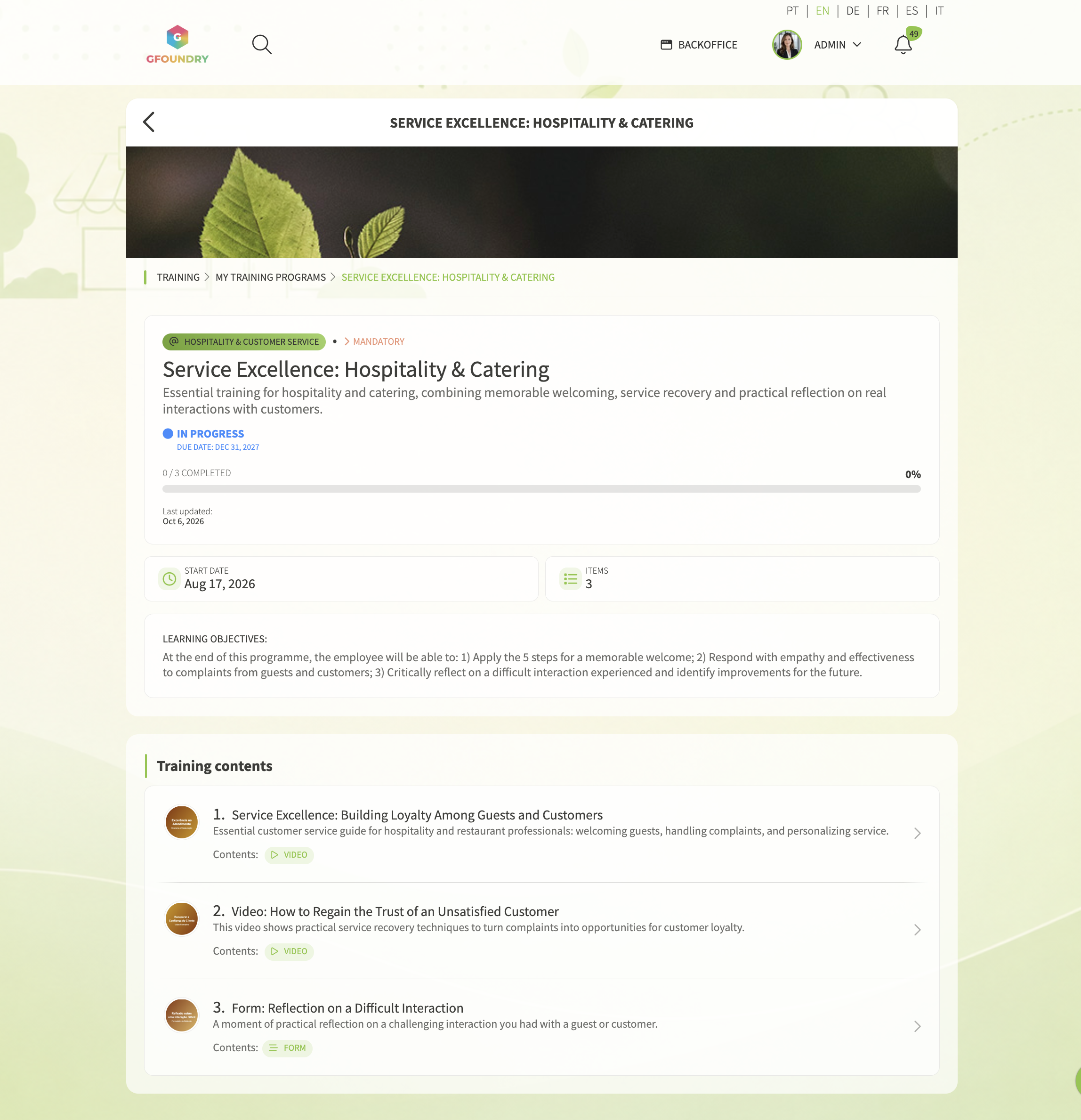
The organisation remains responsible for selecting the critical work, checking the documentation and deciding what evidence demonstrates safe execution. Content completion on the platform should be interpreted alongside that evidence. The method proposed in this article can be configured using appropriate resources; it does not constitute an automatic knowledge-transfer process.
Checklist before considering the handover complete
- Priority tasks are described in terms of concrete results.
- The main exceptions, decisions and limits of autonomy have been recorded.
- Materials have an official reference, an owner and a review date.
- A named recipient has sufficient time and appropriate access.
- A test proportionate to the risk has been carried out and the evidence recorded.
- Gaps have owners, support measures and a next review point.
- Continuity does not depend on shared passwords or the informal availability of the person who left.
After the transition, review the record at the first relevant real-world use and whenever the process changes. Observe where help was needed, which errors recurred and which materials were hard to find. These signals help improve the next handover without turning knowledge maintenance into a burdensome project.
To begin, choose a task that currently depends on a single person. Identify who should be able to perform it, observe a real or simulated case and update the documentation based on the questions that arise. That small exercise makes visible the difference between available information and knowledge the team can use.