Competitions with KPIs
Your data. A shared challenge.
Turn sales, contacts, deliveries or support results into competitions that make progress visible. Bring clear goals, rankings and recognition together to involve people, teams and Communities.
Competitions with your data
A clear goal. A result people can follow.
The Competitions module uses your organisation’s indicators to create individual or collective challenges. The experience starts with real work: people can understand the goal, follow their position and see how their contribution counts.
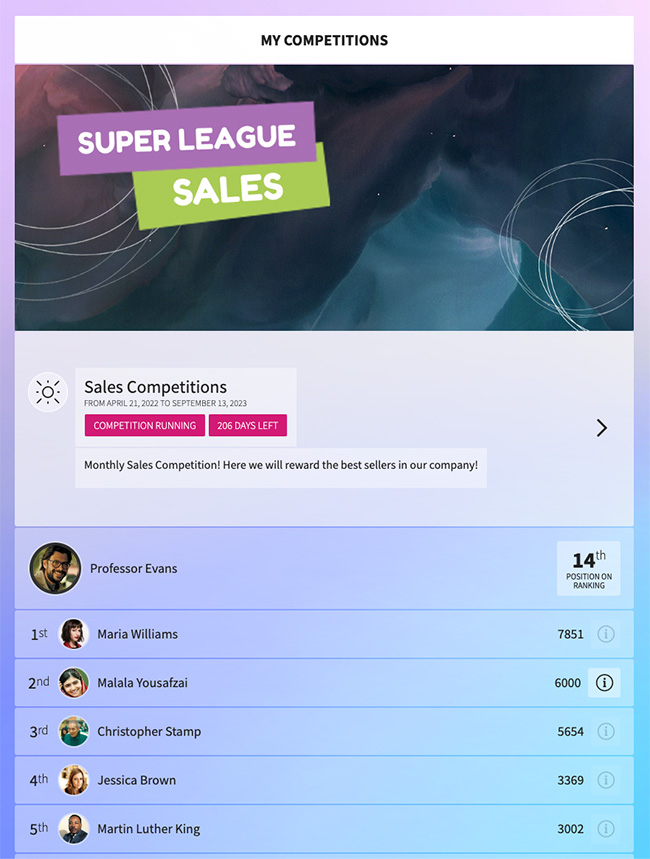
An example of a competition and ranking in the Competitions module.
Choose the indicator and the dynamic.
Sales, contacts, signed contracts, deliveries or resolved support incidents can become a competition. Participation can be organised by person, team or Community, according to the programme’s objective.
Update the results.
Data can be updated through XLS files or API integrations with other platforms. The connection and update frequency are agreed as part of the project, so the ranking reflects the data available.
Give recognition meaning.
Medals and rewards make results visible. Rules should be clear and suited to the work: rewarding volume fits some challenges; in others, quality or fewer incidents is the more relevant indicator.
Applications at work
Sales and contacts. A challenge the team understands.
A competition works best when its indicator is understandable and relevant to participants. The same mechanisms can support different objectives, with rules and periods defined for each context.
Commercial teams.
Create monthly competitions around sales, contacts made or contracts signed. Following results during the period connects everyday effort with the goal; at the end, medals and rewards can recognise performance.
Call centres.
Run challenges based on contact numbers or sales results, individually or by team. In a collective competition, contacts made by each member contribute to a shared result, creating a reason to collaborate and exchange useful practices.
Quality and response
A better result can also mean fewer incidents.
A ranking does not always need to reward the highest number. It can reflect what matters to the operation and the customer, whether that is reducing delivery incidents or improving support response capacity.
Transport and deliveries.
Create driver competitions based on delivery incidents during the month. A ranking from the lowest to the highest incident count lets you recognise the strongest results on that indicator. The DPD Portugal case shows this approach in context.
Technical and support teams.
Resolving errors and problems is central to customer response. Run competitions based on the number of incidents resolved in a period, recognising individual contributions and following team results. Rules should consider the nature of the work so the challenge supports a useful response.
Learning and adoption
Use the challenge to support new processes.
The gamification engine and Competitions module can also support onboarding and the adoption of new processes, including software. A competition has meaning when it helps people move through a change they need to make.
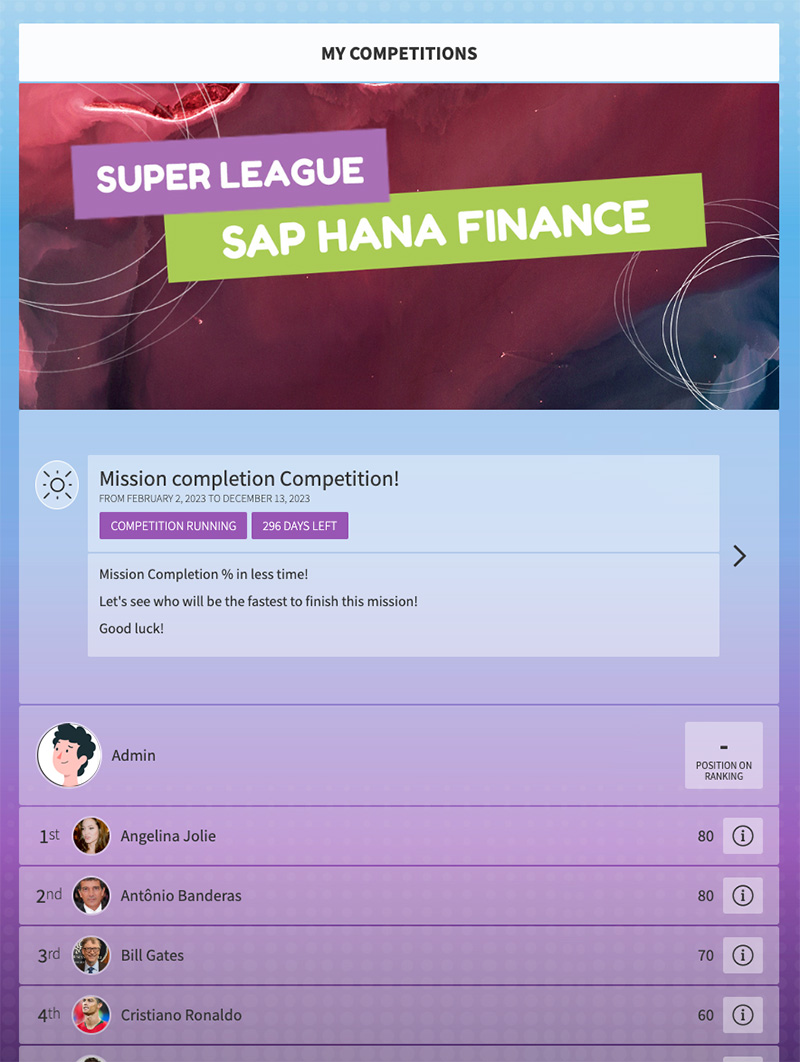
An example of a competition supporting software adoption.
Define adoption goals.
Connect the challenge with process objectives and recognise the people or teams that reach them. Where speed is relevant, it can be part of the challenge while keeping learning and correct use in view.
Build a coherent narrative.
A narrative that fits your organisational culture gives context to the rules and rewards. It helps make change more participative and interactive, with a purpose that goes beyond moving up a ranking.
Frequently asked questions
Competitions. Your questions, answered.
Can we use data from other platforms?
Yes. Results can be updated through XLS files or API integrations. The connection, data and update frequency are configured according to the project.
Can we create team competitions?
Yes. Competitions can be individual, by team or by Community. For example, contacts made by team members can contribute to a collective result.
Can a ranking reward fewer incidents?
Yes. The indicator should reflect the objective: a delivery challenge can rank drivers from the lowest to the highest incident count and recognise the strongest results.
Which plan should we choose?
Compare the modules and services in the current plans and discuss the indicators, participants and integrations your programme needs with us.