
The training catalogue has grown. Opportunities to learn may not have grown with it. To make reskilling a real possibility, we need to look at four conditions: access, time, relevance and application at work.

Imagine an organisation offering the same course to every team. Office workers can set aside time, use a computer and ask a colleague for help. Someone working an operational shift finds the invitation at the end of the day, relies on a shared device and does not know when they will be able to stop. The offer is the same. The opportunity to learn is different.
This is a hypothetical example, but it helps frame a question that enrolment figures do not always answer: who can actually benefit from the investment in development?
In its Global Workforce Hopes and Fears Survey 2026, published on 29 September, PwC reports an indicator of workers’ access to learning and development resources of 51%, compared with 59% the previous year. The study collected responses from 49,364 workers across 48 countries and regions in May and June 2026. This is an international signal based on participants’ responses, rather than a specific measure of Portuguese companies or an audit of the availability of their training catalogues.
For HR, L&D and operational managers, the useful question is this: what happens between making training available and someone being able to learn, practise and develop?
Reskilling starts with changes in the work
Reskilling means developing skills to take on different tasks or roles. Upskilling deepens or updates the skills needed in a current role. In practice, the two can coexist: a team learns to use a new tool while some people prepare for responsibilities that did not previously exist.
The starting point should be a specific change in the work. “We need AI training” is too broad. “We need the team to know how to check an AI-generated summary before using it in a response” identifies a task, a risk and an observable behaviour. The second formulation helps select content, design exercises and decide who needs support.
It also avoids treating every difficulty as a knowledge gap. If a procedure is contradictory, system permissions are missing or targets penalise time spent learning, adding a course may leave the problem untouched. The diagnosis should distinguish what requires training from what requires a management decision.
Four conditions for turning availability into opportunity
- AccessBeing able to reach and use the content
- TimeProtected time, with operational cover
- RelevanceUnderstanding its purpose and where to start
- ApplicationA real opportunity to put learning into practice
1. Access: being able to reach and use the content
Creating an account is only the beginning. People need to be able to sign in, find the right learning path, understand the language and use the materials on the device available to them. For distributed teams, this may mean reviewing connectivity, accessibility, captions, user support and access conditions during a shift.
A simple check is to accompany people in different roles and working hours from the invitation through to the first exercise. Where do they hesitate? What information is missing? Can they resume the learning path after an interruption? This test reveals barriers that a demonstration on the training team’s computer may not show.
2. Time: protected time, with operational cover
A short course still requires attention. When learning depends on an unlikely break or on personal time, participation tends to depend on the room each person can find in their day.
The CIPD report Lifelong learning in the reskilling era, published in August 2025 and focused on the UK, identifies time, cost, employer support and clarity about options among the barriers to adult learning. It cannot quantify those barriers in a Portuguese company, but it offers relevant questions for a diagnosis.
Before launching a learning path, the manager and L&D should agree when learning will take place, who will maintain service continuity and what to do when the planned period is interrupted. “Training available at any time” should not become “training that everyone has to fit in on their own”.
3. Relevance: understanding its purpose and where to start
A large catalogue can make choosing more difficult. People need to recognise the connection between what they learn, the problems they face and the development opportunities presented to them.
Instead of recommending an entire library, propose a learning path with an explicit objective, entry requirements and a clear first step. Recognise prior knowledge: someone who already demonstrates a skill may need advanced practice, while a colleague benefits from a supported introduction. Differentiating the path does not mean making assumptions about ability based on age, job title or apparent familiarity with technology.
4. Application: a real opportunity to put learning into practice
Completing content is not the same as using a skill. If someone returns to the same work without an opportunity to apply what they have learnt, training remains separate from the activity it was meant to improve.
Define an application task and who will provide feedback from the outset. This might involve solving a simulated case, carrying out an operation under supervision or explaining a decision based on a procedure. In critical activities, practice must respect supervision and safety criteria; a quiz does not replace the professional validation the task requires.
What microlearning can solve, and what needs more
Microlearning organises content into units focused on a specific objective. It can help explain a change in procedure, prepare an exercise or recall a concept at the moment it is needed. Its practical advantage lies in focusing each unit on a recognisable need.
But splitting a long presentation into several videos does not, in itself, create a learning path. The connections between topics need to be explained, prior knowledge needs to be recalled and opportunities for practice need to be created. Some objectives require longer sessions, discussion, lab work or support on the job.
One possible combination, to be adapted to the context, is to introduce a short concept, ask for a decision in a scenario, discuss the response and return to the topic after a real experience. Duration serves the objective; it should not be the main criterion of quality.
AI can support preparation. Responsibility remains human
AI can help structure materials, suggest examples and prepare questions. It is particularly useful when scattered internal knowledge needs organising. However, producing content faster does not guarantee that it is correct, suited to the audience or addresses the difficulty identified.
A training brief should specify the task to be learnt, the audience, authorised sources, excluded topics and how learning will be demonstrated. Review needs to test the accuracy of explanations and answers, the suitability of examples and the clarity of language. In regulated or safety-related matters, validation should be carried out by someone qualified to do so.
It is also important to distinguish content adapted to a brief from a learning path automatically personalised for each person. These are different capabilities. Neither should be assumed simply because a solution uses AI.
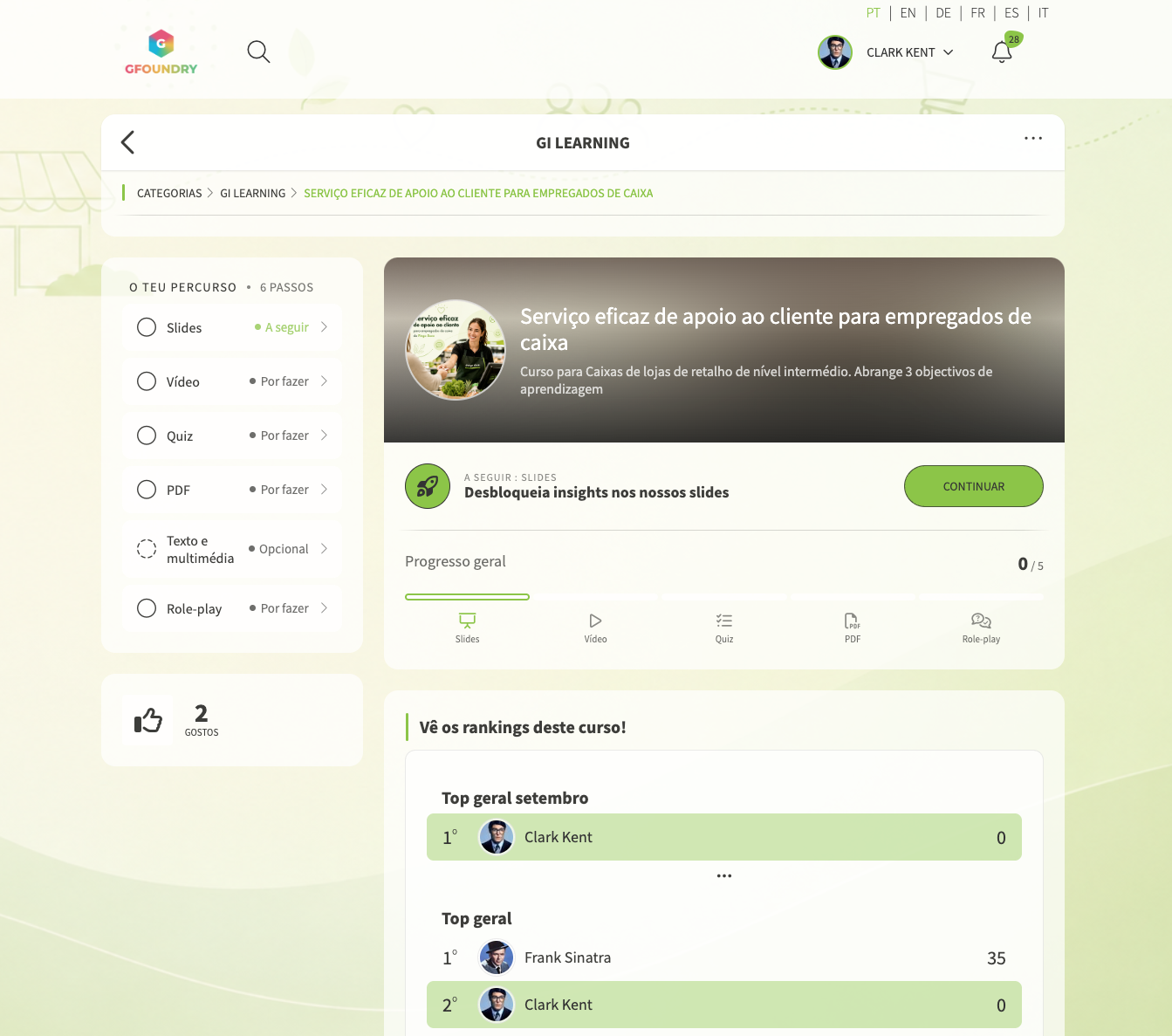
In GFoundry, the Learning Designer, also known as Gi Learn, lets you prepare a course from a brief or PDF, define objectives and an audience, and choose content blocks. The agent presents a summary for confirmation before generating the course; the result can be reviewed and edited before publication. This supports production. Deciding what to teach and validating the material still require human review.
For step-by-step instructions, see the Learning Designer guide in the Help Center.
Measure where people drop out of the learning path
A completion total is useful for tracking delivery, but says little about who was left out and why. It helps to observe distinct stages, keeping definitions consistent and comparing groups with similar conditions:
- Access: can the intended participants use the learning path? What technical difficulties or problems with understanding have been identified?
- Participation: who has started and who has not? Was time for learning actually made available?
- Learning: which concepts or decisions still lead to mistakes in a relevant exercise?
- Application: what task was carried out after training, with what support and against which criteria?
Do not turn these questions into a ranking of people. A difference between shifts may reflect operational cover, access to equipment or opportunities for practice. Before attributing the difference to motivation, compare the records with what teams describe.
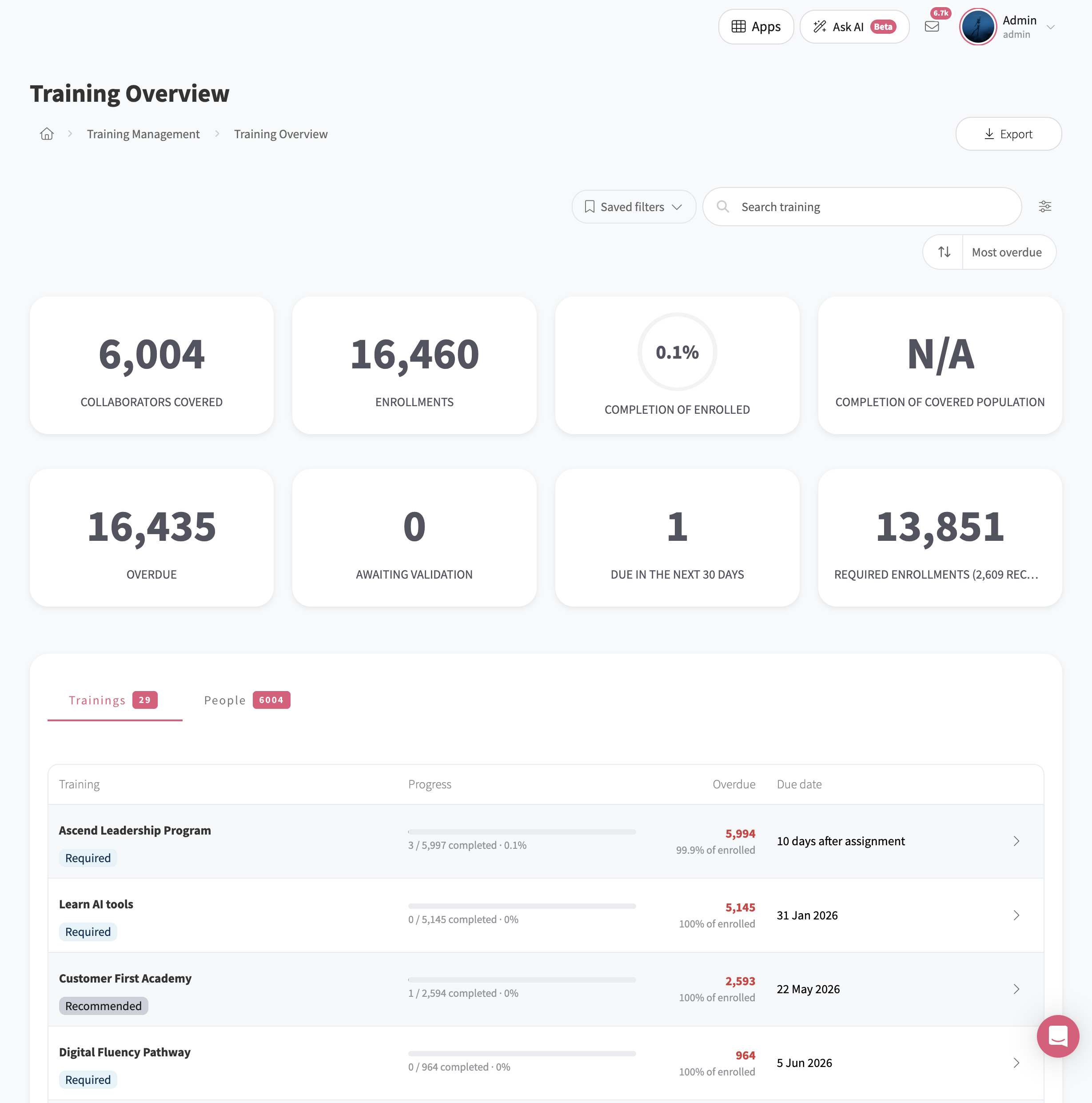
GFoundry’s learning reports let you consult progress and results at different levels, including content, quizzes and programmes. These records help track the learning path, but do not, on their own, demonstrate a change in behaviour, productivity or financial return. Such conclusions require additional criteria and attention to other factors that may have changed.
A starting point: one skill, different audiences
Before expanding the catalogue, choose a relevant skill and observe how people with different working conditions can develop it. For example, in a hypothetical exercise about adopting a new process, the objective might be to identify an exception and route it correctly.
- Describe the task. Define what the person will need to be able to do and how it will be observed, rather than starting with a list of content.
- Validate the conditions. Confirm access, time, support and opportunities for practice with the participants and their manager.
- Build the learning path. Combine only the necessary resources: explanation, example, exercise and feedback. Add support when digital content is not enough.
- Review the barriers. Listen to participants and non-participants. Adjust access, work organisation or materials according to the cause identified.
- Decide the next step. Only after observing learning and application should you choose what to retain, correct or expand.
When a formal structure is needed, GFoundry Training Programs let you group content, define audiences, enrolment rules, dates and evaluation stages. The feature depends on being enabled in the organisation and on management permissions. Configuration should reflect the programme’s decisions, rather than replace them.

To configure audiences, enrolments, scheduling and evaluation, see the Training Programs guide in the Help Center.
Gamification can make progress visible and recognise participation. It should support relevant objectives and comparable access conditions. Rewarding completion speed alone, for example, may favour those with more time and distract from practice.
A reskilling strategy becomes more credible when it can answer two questions: who had a real opportunity to learn, and what can that person now do? The catalogue is a resource. The outcome depends on the complete learning path.