

Managers are asked to give useful feedback, resolve conflicts, clarify priorities and support each person’s development. But who helps them do that work better? Who observes a difficult conversation, discusses a poorly judged decision or protects the time needed to learn?
The question matters to HR, learning and development teams, and senior leadership. When the answer amounts to an annual training course, a content library or a request to “be more of a leader”, an essential part of the problem remains unresolved: how to turn what people learn into consistent decisions and behaviours at work.
The context deserves attention. In Gallup’s State of the Global Workplace 2026 report, the proportion of managers classified as engaged at work fell globally from 27% in 2024 to 22% in 2025. These figures do not demonstrate that a lack of training caused the decline, nor do they describe Portuguese managers specifically. They do, however, underline the importance of looking at those responsible for supporting others.
Developing managers requires a practical combination: relevant learning, guided practice, opportunities to apply it and organisational conditions that enable improvement. A cycle of 30, 60 and 90 days can help give that commitment a clear shape. The plan, cadences and criteria presented here are a proposed approach to implementation, to be adapted to each organisation’s context. The timeframe organises practice and support, without promising mastery of leadership in three months.
Managers also need someone to develop them
There is a common imbalance in leadership programmes: they describe in detail what managers should do for their teams, but leave it unclear what the organisation will do for its managers.
Someone promoted for their technical knowledge may need to learn how to delegate, discuss expectations and intervene in a disagreement. An experienced manager may face a new context: a larger team, distributed responsibilities or priorities that change every week. Length of time in the role, on its own, does not identify the support needed.
The starting point should be a work situation. “Develop communication skills” is too broad to guide practice. “Discuss a recurring delay without accusing the person and finish with an agreement that can be checked” already makes it possible to prepare an exercise, observe the behaviour and decide what to improve.
It is also useful to distinguish a learning need from an organisational problem. If two departments demand incompatible deliverables, training on priorities will have limited reach until someone decides which takes precedence. If a manager supports too many people for the time available, teaching listening techniques will not create space in the diary.
The diagnosis should therefore ask two questions together: which behaviour needs to develop, and which working condition is preventing that development?
Before day one, agree on focus, support and time
The cycle starts with a conversation between the participating manager and their own manager, supported by HR or L&D. That conversation should lead to a simple commitment: one priority capability, the situations in which it will be practised, who will provide support and how progress will be recognised.
Choosing one priority means leaving others for later. A manager who postpones feedback conversations does not need to start with negotiation, strategic thinking, change management and public speaking at the same time. They can first work on the ability to prepare, conduct and follow up a conversation about expectations.
Time should be scheduled and reflected in the workload. In one example of how to organise the programme, participants could reserve a weekly 45-minute block for preparation and reflection, a fortnightly 30-minute conversation with their manager, and a monthly meeting with peers. Teams working shifts will need cover and compatible schedules.
Protecting time means deciding what will stop happening during that period. A session that is repeatedly cancelled to deal with urgent issues communicates a different priority from the one set out in the development plan.
Responsibilities also need to be explicit:
- The participating manager prepares situations, experiments and asks for specific feedback.
- Their own manager supports application, helps interpret difficulties and removes obstacles within their remit.
- HR or L&D provides resources, supports the quality of the exercises and reviews whether the programme is useful.
- Senior leadership ensures the conditions for participation and intervenes when the problem requires decisions about resources, objectives or authority.
A mentor or peer group can complement this support. Responsibility for developing the manager still requires involvement from those who define and oversee their work.
A cycle of practice over 30, 60 and 90 days
-
Days 1 to 30: observe and rehearse
Start with a work situation, define observable behaviours and rehearse with specific feedback.
Evidence: understands the expected behaviour, can rehearse it with support and identifies an opportunity to apply it.
-
Days 31 to 60: apply and reflect
Try it in appropriate situations, discuss what happened and adjust the next attempt.
Evidence: examples of application at work, reflection on the responses observed and identification of obstacles.
-
Days 61 to 90: test consistency and decide
Apply it under different conditions, compare with the starting point and decide the next step.
Evidence: autonomy and consistency against the same criteria, or a record that there was no opportunity to observe.
Days 1 to 30: make the capability observable and rehearse
In the first month, the aim is to build a practical foundation for practice. Rather than starting with an extensive set of learning materials, select a recent situation and ask the manager to explain what happened, what they tried to do and where they encountered difficulty.
It might be a postponed feedback conversation, a delegated task that returned to the manager or a meeting in which every task was classified as urgent. The initial record should contain only the necessary information, without exposing personal data or confidential details about colleagues.
From there, define behaviours that can be observed. For a feedback conversation, for example: present a specific fact; explain its impact; listen to the other person’s perspective; agree on a next step; schedule follow-up. This outline helps identify where the difficulty lies. Knowing how to start the conversation and knowing how to reach an agreement are related but different capabilities.
Learning content should serve that diagnosis. A short explanation, an example with commentary and a simulation can form an initial set of activities. The simulation makes it possible to pause, discuss alternatives and try again before tackling a real situation.
Feedback on the rehearsal should refer to behaviour. “There was a lack of empathy” leaves the person unsure what to change. “You proposed the solution before asking what had made the delivery difficult” identifies a choice that can be reconsidered. Empathetic leadership takes a practical form here: listening becomes an observable action in the conversation.
At day 30, the review should confirm three things: the manager understands the expected behaviour, can rehearse it with support and has identified a suitable opportunity to apply it. A positive result in an exercise makes it possible to move on to a real experience; it does not yet demonstrate consistency at work.
Days 31 to 60: apply it at work and discuss what happened
The second month focuses on application. The manager chooses appropriate situations in which to try the behaviour and prepares for them with the agreed support. The challenge should be real enough to generate learning and sufficiently bounded to allow follow-up.
Not every situation is suitable for practice. Suspected harassment, discrimination or other sensitive incidents should follow the organisation’s channels and procedures, with specialist support where needed. A development programme should not turn these cases into peer exercises.
After an application, a brief reflection can be organised around four questions:
- What was I trying to achieve?
- What did I actually do?
- What response did I observe, and what information surprised me?
- What will I keep or change at the next opportunity?
These questions help avoid two extremes: a general account that “it went well” and a report too burdensome to maintain. The record should make it possible to discuss a decision and adjust the next attempt.
The manager’s own manager has an active role here. They can help prepare the conversation, analyse a delegation plan or discuss alternatives after the application. Attendance at a real interaction should only happen when it is appropriate and known to the people involved. Recording conversations or collecting identifiable accounts should not be the automatic choice for a training programme.
A peer meeting can add perspectives: how to respond to a defensive reaction, what to do when there is no agreement or how to make the limits of autonomy explicit. Cases should be de-identified, keeping the focus on the manager’s behaviour and avoiding turning the meeting into an informal assessment of team members.
At day 60, it is important to look for evidence of application and understand the obstacles. If practice has not yet happened, the response may involve improving the exercise, creating an opportunity or reviewing the workload. Adding more content without understanding the blockage rarely clarifies the problem.
Days 61 to 90: test consistency and decide the next step
In the third month, the aim is to check whether the behaviour is starting to hold across different situations. One well-conducted conversation in a straightforward context does not establish that the manager can do the same when there is resistance, deadline pressure or incomplete information.
The manager and their own manager choose a new application that adds a proportionate level of difficulty. Someone who has worked on feedback can practise following up an agreement that has not been fulfilled. Someone who has worked on delegation can clarify decision-making boundaries for a less predictable task. Someone who has worked on priorities can prepare a conversation in which they need to propose postponing a deliverable.
The final review should compare the starting point with recent examples, using the same criteria. A simple framework can distinguish four situations: not yet demonstrated; demonstrated with support; demonstrated independently in one situation; demonstrated consistently across different situations.
Add one essential option: “no opportunity to observe”. An absence of evidence should not automatically be interpreted as an absence of capability. When opportunities vary between participants, the programme needs to recognise that difference.
At the end of 90 days, the decision may be to keep practising the same capability, reduce support, choose a new priority or address an organisational barrier. The review should end with a specific decision and a follow-up date. Completing the calendar leaves the essential issue unresolved if nobody knows what happens next.
An example: from postponed feedback to regular follow-up
Consider the following illustrative example, unrelated to any real client. A team manager tends to fix incomplete work herself. She avoids discussing the problem because she fears demotivating people. The chosen objective is to learn how to discuss expectations and follow up the commitments agreed.
In the first 30 days, she analyses a situation, prepares an opening based on facts and rehearses the conversation with a peer. The feedback shows that she explains the impact well but immediately proposes the solution. In the next attempt, she practises questions that help her understand what made delivery difficult.
Between days 31 and 60, she applies the outline in a suitable situation. She discovers that part of the difficulty comes from contradictory instructions. Her manager helps clarify the priority, and she agrees with the person on a next step and a date to review the outcome.
Between days 61 and 90, she practises follow-up: what has been done, what remains blocked and what adjustment is needed. In the final review, the evidence sought is specific: she presented facts, listened before reaching a conclusion, clarified expectations and revisited the commitment on the agreed date.
The example also shows why the outcome of a conversation depends on more than technique. A good question can reveal a process problem that the manager cannot solve alone. Developing her includes helping her recognise that limit and ask for the decision needed.
Measure progress without confusing attendance with capability
Follow-up should separate questions that often get combined in the same indicator.
Participation: did the manager have access to the resources and manage to use the scheduled time? Completion of activities helps identify participation and barriers to access.
Learning: do they understand the principles and can they use them in an exercise? A knowledge test or simulation can provide evidence of this dimension.
Application: did they use the behaviour in real work? Analysis of a decision, a follow-up agreement or an appropriate observation can help answer this question.
Consistency: did they do it again, independently, under different conditions? This question requires more time and more than one episode.
Effects at work: were there relevant changes for the team or the operation? For example, clarity of priorities or the need to redo work can be monitored, provided there is a shared definition and context for interpreting the data.
An improvement observed during the programme does not, on its own, prove that the programme caused it. Changes in the team, workload or processes may also explain the outcome. The purpose of indicators is to support honest decisions about development, avoiding promises of impact that the available evidence cannot support.
Also explain to participants what information is collected, who can consult it and which decisions it will inform. A practice space loses its usefulness if people later discover that every attempt was treated as a definitive rating of their ability to lead.
How GFoundry can support this cycle
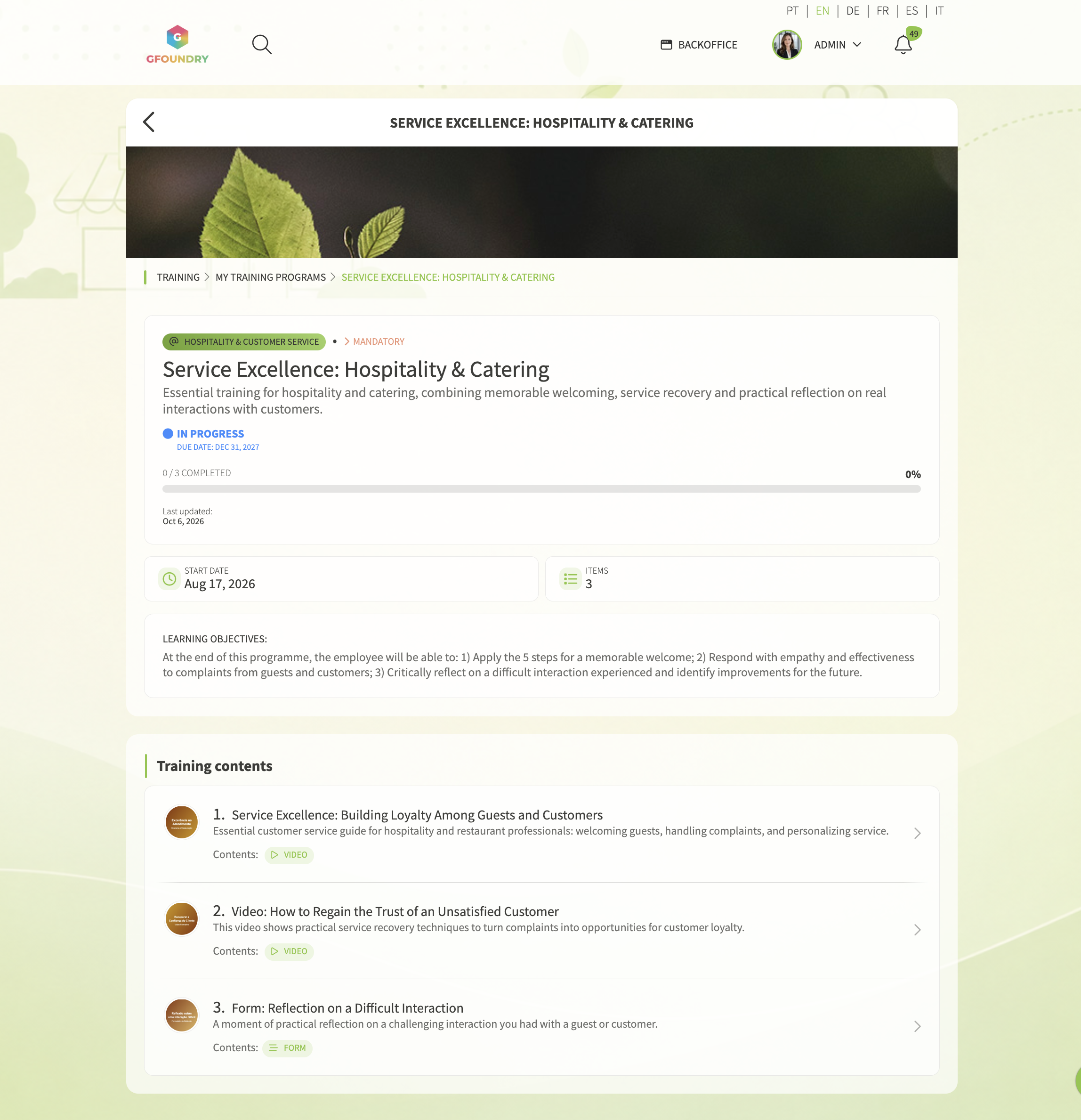
Technology can organise resources and assessment moments, making the agreed pathway clearer. In GFoundry, Training Programs bring content together, define recipients and deadlines, and allow stages such as Initial Assessment, Knowledge Test and Validation to be configured. Validation can take place after an interval and be carried out by the person themselves or their direct manager, depending on the configuration.
In a programme for managers, this structure can help distinguish the starting point, learning and a later check on application. The quality of that check still depends on the criteria defined and the evidence examined.
Role Play, integrated into Learn Content, allows people to practise conversations with an AI persona and receive an assessment against criteria. It can support preparation for situations such as giving feedback or discussing priorities. Scenarios should be reviewed and tested before being made available; the result of a simulation does not replace observation of professional practice.
For organisations structuring learning more broadly, the guide to building an internal academy complements this approach. Here, the unit of change is closer to everyday work: one manager, one priority capability and a cycle of practice with support.
Developing those who lead is a shared responsibility
Asking managers to develop their teams means making an equivalent commitment to them. That commitment becomes visible when someone is available to support them, time can actually be used and criteria help establish what is changing.
To begin, choose a leadership situation that needs to improve. Define the expected behaviour, agree on support and reserve the first opportunity to practise. At the end of 30, 60 and 90 days, review the evidence and working conditions together.
The opening question should have a concrete answer: who develops this manager, at which moments and with what responsibility?
Sources
- Gallup — State of the Global Workplace 2026: global data on managers’ engagement at work in 2024 and 2025.
- GFoundry Help Center — Training Programs: programme organisation and assessment stages.
- GFoundry Help Center — Role Play: what it is and why it matters: practising conversations with an AI persona and assessment against criteria.
- GFoundry Help Center — Designing a Role Play with the AI Designer: designing, reviewing and testing scenarios.