
Artificial intelligence in HR already helps organisations find candidates, answer questions, prepare training and explore people data. But these tasks require different solutions. This guide explains what is already happening at each stage of the talent lifecycle and compares Workday, SAP, Oracle, Eightfold, Cornerstone, Factorial and GFoundry.
Imagine someone’s journey through a company. Before they join, somebody looks for skills that match a role. On their first day, questions arise about procedures. Later, they need to learn, practise a difficult conversation, receive feedback and understand their opportunities to develop. AI can play a part in all these moments. What changes is the information it needs, the work it performs and the responsibility it should be given.
Asking which AI platform is best for HR is therefore only a starting point. A more specific question makes comparison possible: which part of the work do we want to improve, for whom and within what limits? An assistant that explains a policy, a system that recommends candidates and an agent that prepares a course are different solutions.
How this comparison was prepared: capabilities checked against suppliers’ public documentation on 15 October 2026; independent research used to discuss adoption, work and risks. This is an editorial analysis published by GFoundry, rather than an independent test of the seven platforms. The selection brings together relevant HR suites and specialist solutions; it is not a market-share ranking. Availability, language, modules, usage allowances and licences should be confirmed for each proposal.
Artificial intelligence in HR: the essential concepts
The term “AI in HR” covers technologies that do different jobs. Understanding the distinction helps avoid buying one capability while expecting another.
- Rules-based automation: follows a predefined sequence. When someone joins the company, they receive a task list and a training invitation. This can be useful without involving AI.
- Recommendation or predictive AI: identifies patterns in data to suggest a match or estimate a possibility. It might relate skills to roles. A prediction is an estimate, not a certainty about a person.
- Generative AI: produces text and other content from instructions and context. It can prepare a job description, summarise feedback or suggest questions for an exercise. A fluent answer can contain errors.
- Assistant: describes the interaction experience, often through conversation. It can answer questions, find information and help prepare work. The name alone does not tell us whether it can take actions.
- Agent: uses a goal, context and tools to perform steps in a task. It can retrieve information, prepare a result and, when authorised, trigger an action. Its degree of autonomy depends on the implementation.
An LLM, or large language model, is one of the technologies used to understand and generate language. It powers many generative experiences, but it is not the entire HR system: it does not replace records, permissions, calculations or approval processes.
When an assistant first searches company documents and uses the results to answer, this is often called RAG, or retrieval-augmented generation. Put simply, it is the difference between answering from general knowledge alone and consulting an authorised library before responding. It does not mean the model has been trained on all company data, nor does it remove the need to check the source.
There is another essential distinction: answering, preparing and executing are different levels of involvement. “What are the training rules?” requests information. “Prepare a learning path” requests a draft. “Publish it and enrol the team” changes the system. A demonstration should make these boundaries visible.
What AI already does across the talent lifecycle
The simplest way to understand the market is to follow the work, from the need to hire through to someone’s departure. The examples below describe possible uses across the market; they do not mean every capability is included in every platform.
1. Attract and recruit
AI can help prepare job adverts, organise application information, match skills to requirements and support interview preparation. An applicant tracking system, or ATS, organises the process; AI features can add search, summaries and recommendations.
The most immediate benefit is reducing research and preparation work. The sensitive point comes when a recommendation influences who reaches the next stage. Criteria should relate to the role, be verifiable and allow review. A summary can leave out relevant experience; a match based on incomplete data can exclude someone who would have the capacity to learn.
2. Welcome people and support everyday work
In onboarding, the combination might include a journey with tasks and content, an assistant for questions and referral to a person when a case needs interpretation. “How do I request leave?” differs from “Am I entitled to this leave in my circumstances?”. The first question may have a documented answer; the second may require individual assessment.
The same principle applies to HR service delivery: finding a policy, explaining a procedure or showing the status of a request are different problems from approving an exception. A good assistant shows where its answer comes from and recognises when the available information is insufficient.
3. Learn and practise
Generative AI can structure a course from existing materials, prepare exercises and help adapt the language to an audience. Other solutions recommend content based on a role or identified skills. Conversation simulations let people practise situations such as giving feedback, handling an objection or dealing with an unhappy customer.
Quality depends on objectives, sources and review criteria. Generating training does not prove that someone has learned; completing a simulation does not, by itself, demonstrate performance at work. The technology needs to connect to real opportunities to apply learning, as we discuss in the article on access to learning and reskilling.
4. Support performance, skills and mobility
A manager can receive help writing a clearer goal or organising evidence before a development conversation. A skills platform can suggest learning, projects or roles that fit someone’s experience.
These suggestions help explore possibilities. They should not turn an incomplete history into a verdict on potential. Someone may have skills that have yet to be recorded; another person may need an opportunity their history cannot predict. Assessment, promotion and career development require context and dialogue.
5. Listen to teams and understand patterns
In employee listening and people analytics, AI can help explore data, summarise themes or formulate follow-up questions. People analytics simply means using data about people and work to understand a situation and support decisions.
A drop in programme participation deserves investigation, but does not prove disengagement. It may reflect schedules, access, changes in the target group or a technical problem. Likewise, taking part in an initiative does not reveal someone’s psychological state. Useful analysis connects numbers to definitions, time periods, populations and context.
6. Prepare for departures and preserve knowledge
When someone leaves, AI can help organise handover materials or synthesise themes from exit interviews. Equipment returns and access revocation still need owners and confirmations; many of these tasks use rules-based automation.
Organisations also need to decide what information to retain, for how long and for what purpose. Summarising a conversation does not make it legitimate to reuse its content indefinitely, nor does it guarantee anonymity in a small team.
Seven HR platforms with AI: how do they compare?
An HCM suite brings together several people management processes, including administration, recruitment and talent. An HRIS is, essentially, the HR information system. An LMS organises and tracks learning. The boundaries overlap: a suite may include an LMS, while a specialist platform may integrate with the HRIS.
The choice does not always have to be between replacing everything and adding a chatbot. It may make sense to retain the administrative system and add a learning, practice and engagement experience. In the table, “relationship with GFoundry” is our interpretation of the solutions’ scope, not certification of a ready-to-use integration.
| Platform and focus | Documented AI examples | Relationship with GFoundry |
|---|---|---|
| Workday Enterprise HR suite |
Agents and assistance in recruitment, mobility and HR operations, depending on the contracted offering. | Consider it when the central requirement is an enterprise suite. GFoundry can be evaluated for learning, practice and engagement, with integration to be defined. |
| SAP SuccessFactors / Joule HCM and talent suite |
Assistance and agents linked to skills and development. The Learning & Skills Agent can recommend learning and assign it after confirmation. | Overlap in learning and development. Compare the intended experience and SAP ecosystem dependencies with GFoundry’s combination of modules and agents. |
| Oracle Fusion Cloud HCM HCM suite |
Support for job adverts, applications, HR questions, goals, feedback and development; includes agent experiences. | Broad administration and talent coverage. GFoundry should be compared on the development and participation processes the organisation wants to improve. |
| Eightfold AI Talent intelligence |
Skills matching for talent acquisition, internal mobility, development and opportunities. | Particularly relevant when the problem is finding and matching talent to opportunities. GFoundry brings together learning, practice and engagement experiences. |
| Cornerstone Galaxy Learning and talent |
Recommendations, skills, content assistance, AI simulations and workforce analysis. | Direct competition in parts of learning and development. Compare creation, practice, administration, catalogue, analysis and the employee experience; role-play is not exclusive to GFoundry. |
| Factorial / One HR operations and business management |
An assistant connected to company information and tasks, reports and creation experiences; the documentation includes MCP connectivity. | Compare the specific process: HR operations, learning and talent have different depths and dependencies. Confirm each solution’s scope in a demonstration. |
| GFoundry Intelligence Learning, development and engagement |
An assistant for internal knowledge, writing, course creation, role-play and natural-language analysis, alongside People Intelligence and Talent Insights. | Consider it when the priority is connecting knowledge, learning, practice and talent follow-up. Do not assume it replaces payroll or a specialist ATS. |
Agent names alone are insufficient to compare proposals. Workday’s documentation distinguishes early-access agents from available agents and identifies purchasing requirements. In SAP, the learning example depends on specific components, integration and permissions. “The platform has agents” does not mean “this task is included and active in our installation”. Consult the Workday agent catalogue and the SAP capability requirements linked in the table.
The seven solutions have not been evaluated here using the same data, users and scenarios. A list of publicly documented capabilities helps prepare a shortlist; it does not establish which will deliver better answers, require less implementation effort or provide a better return in your organisation.
What does GFoundry Intelligence do in practice?
GFoundry Intelligence brings together assistance and analysis experiences connected to the platform. To understand its role, distinguish three jobs: supporting production and access to knowledge, enabling practice, and exploring evidence. Not everything displayed on a dashboard is generated by a language model.
Knowledge and production: Gi, Writing Assistant and Learning Designer
The Workplace Assistant, Gi, helps employees and managers find answers in the knowledge the organisation makes available. Its value depends on the quality and currency of that content and the access allowed. An outdated policy remains a problem even when it is easy to find.
The AI Writing Assistant supports writing in compatible backoffice forms: it can help improve, shorten, correct or translate text. For example, it can turn a technical notice into a clearer communication. Review confirms that the final version preserves the intended rule, date and meaning.
The Learning Designer, also known as Gi Learn, supports course creation from a brief or PDF. The conversation helps clarify objectives, audience and structure before generation. The team reviews the content and questions before publishing. Preparing a course faster does not remove the need for educational or technical validation.
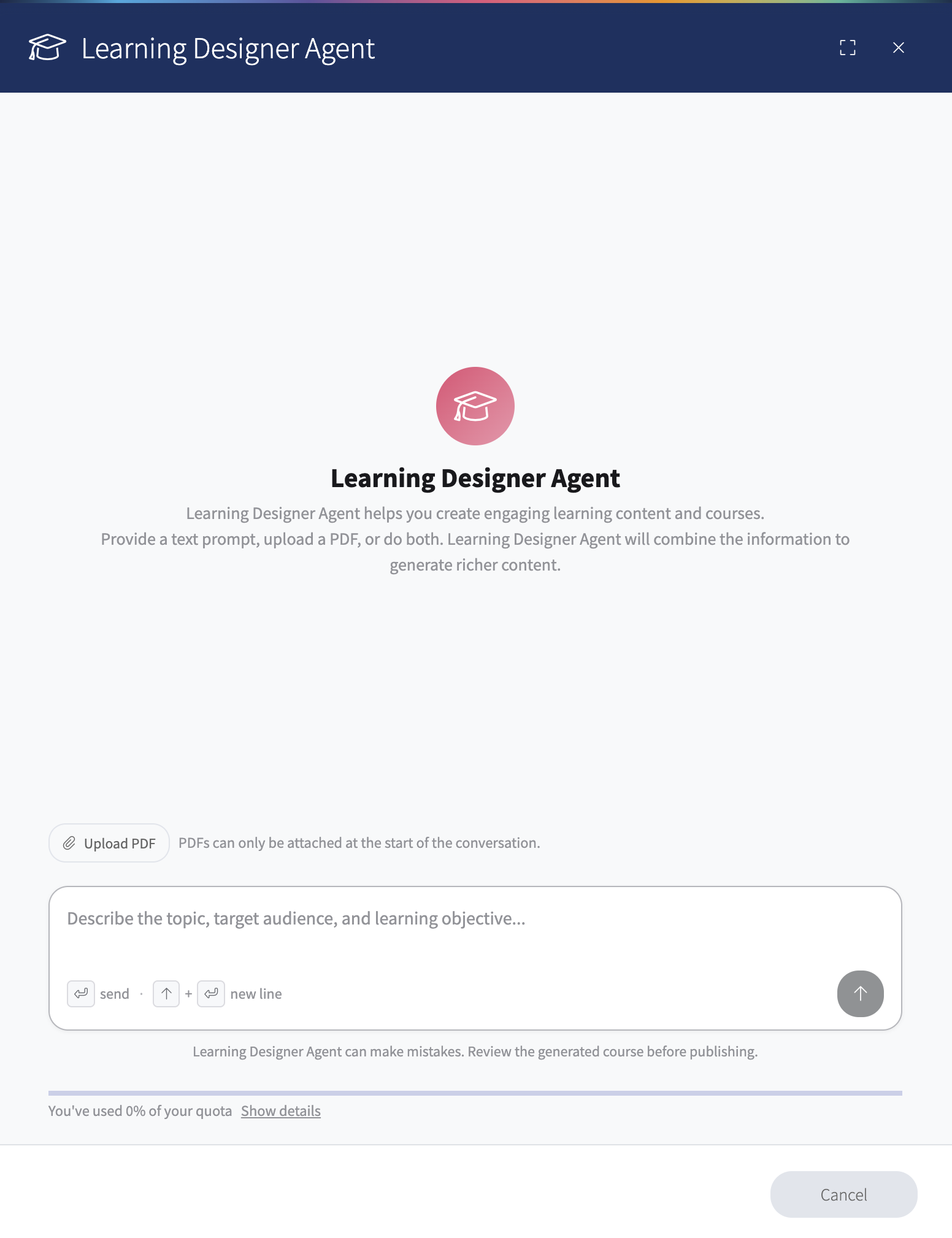
To understand how these elements connect with learning paths, programmes and follow-up, explore GFoundry’s learning and development page. The Learning Designer guide in the Help Center explains the creation steps.
Practice: Role-Play Coach
The Role-Play Coach lets teams prepare conversation scenarios with a character, objectives and criteria. The learner practises and receives feedback against the scenario. This can provide an opportunity to rehearse a feedback conversation or a customer service interaction before facing it at work.
The simulation’s evaluation should be interpreted within those criteria. It is not a personality diagnosis, a universal measure of competence or an automatic promotion decision. Context, scenario quality and human support still matter. The Role-Play Coach guide explains how it works.
Analysis: Talent Strategist, People Intelligence and Talent Insights
The Talent Strategist, described in the functional documentation as the Data Analyst Agent, lets users ask questions about organisational data in natural language and explore answers through tables, charts and Excel exports. This is an analytical experience: the agent has read-only access and does not change evaluations, users or people records.
People Intelligence provides an organisational view through Insights from a curated catalogue. Indicators are calculated by the platform according to defined rules; they are not numbers invented by an LLM on request. Talent Insights brings that analytical perspective to the individual profile, within permitted access and available sources.
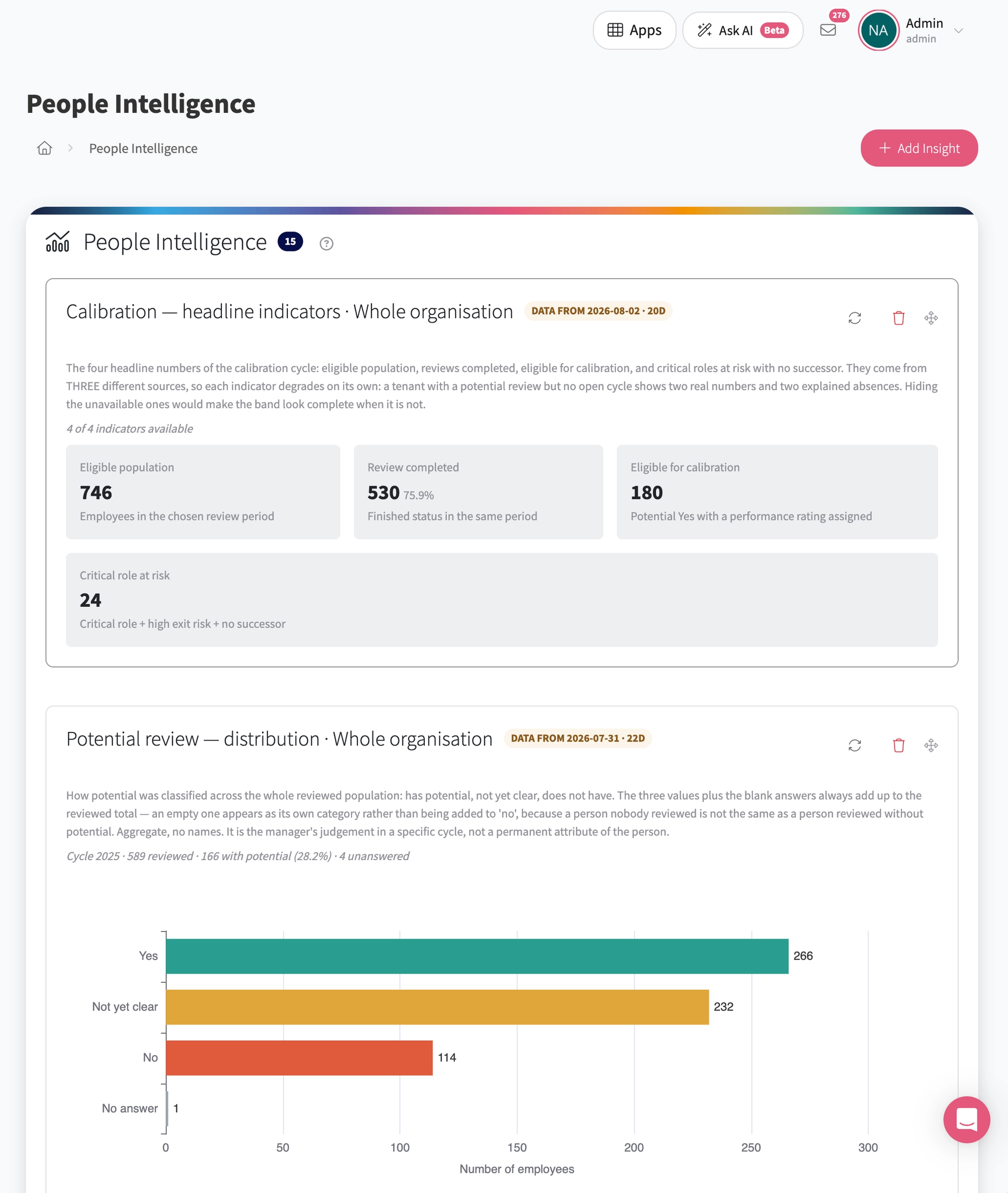
There is an important difference between finding an association and explaining its cause. If training participation and an assessment change at the same time, that does not prove training caused the change. Indicators help identify what to investigate and prepare conversations; they do not replace that investigation.
The Data Analyst Agent guide and People Intelligence documentation explain each experience’s scope, sources and limits in more detail.
Gamification, learning paths, recognition, goals and feedback provide ways to participate and follow development. They are platform components, not synonyms for AI. Combining them can bring a recommendation closer to a concrete activity, but does not make the entire experience automatically personalised or autonomous.
In a hypothetical onboarding example for a customer service team, the Learning Designer helps prepare materials about a procedure; Gi answers questions using the available knowledge; and the Role-Play Coach lets learners rehearse a customer conversation. HR follows the available records and investigates where support is needed. These are complementary jobs, each with its own sources and criteria. This is not a promise that agents execute the entire sequence autonomously: the organisation defines the journey, validates the content and decides on follow-up.
MCP: how an assistant connects to company systems
So far, we have discussed what a platform does inside its own application. The Model Context Protocol, or MCP, addresses a different question: how an AI application can connect to external sources and tools through a common standard. The official MCP documentation describes this connection between applications, data and tools.
A useful analogy is a standardised connection between devices. The standard helps both ends understand each other, but does not decide who can use the equipment or what they are allowed to do. In HR, the assistant is one end; the service exposing authorised platform functions is the other.
An API is an interface through which a system makes operations available to other programs. An MCP service can use those APIs and expose tools to an AI application. MCP therefore does not necessarily replace existing APIs, nor is it the model that writes the answers.
Consider a hypothetical training example. A manager asks to see available programmes. The assistant uses an authorised read tool and presents the results. If the manager then requests draft content, a tool supporting that task will be needed. Publishing or enrolling people requires specific operations and the corresponding controls. Having an MCP connection does not mean all these actions are available.
- The user requests a task. The request should have a clear objective and scope.
- The assistant uses the exposed tools. It should only access information and operations authorised for that connection.
- The system applies its controls. Authentication, permissions, validation and operation logs remain necessary.
- The person reviews the result or confirms the action. Confirmation should match the consequences, particularly when the system will be changed.
In GFoundry, MCP supports connections to compatible external assistants, within a configured scope of tools and integrations. The current offering associates MCP access with Premium; concrete capabilities should be confirmed in the proposal and configuration. The article on GFoundry Intelligence and the TOAR Framework explains the relationship between orchestration, automation and response. TOAR is a Framework; GFoundry Intelligence names the platform’s intelligence solutions.
MCP is not exclusive to GFoundry. Factorial’s documentation, for example, describes connecting One to compatible assistants while applying the user’s permissions. A useful comparison asks which tools exist, what operations they perform and how they are controlled, rather than simply checking a “has MCP” box.
What independent research adds to the discussion
Suppliers explain capabilities. To understand their effects on work, we also need research whose purpose is not to sell one of the platforms in the table.
Adoption and work organisation. In an analysis published in April 2026, the CIPD connects the application of HR and leadership skills with AI adoption. The survey, conducted by YouGov, heard from 1,342 people professionals and business leaders. The analysis highlights work design, skills planning and cross-functional collaboration. These are participant-reported results, not proof that installing a tool produces a particular gain, nor an estimate specific to Portugal.
Task transformation. The ILO study Generative AI and Jobs: A Refined Global Index of Occupational Exposure, published in May 2025, estimates AI exposure at task level. Exposure does not mean job loss. The continued need for human input leads the authors to consider job transformation more likely than complete replacement. For HR, this helps frame a concrete question: which tasks change, and what learning support is needed?
Algorithmic management and trust. The OECD report Algorithmic management in the workplace, published in February 2025, analyses an employer survey. It records benefits perceived by managers, alongside concerns about the systems’ trustworthiness. The lesson for technology selection is to require explanations, accountability and the ability to challenge outcomes. Perceived usefulness is not a causal measure of productivity.
Fairness in recruitment. University of Washington researchers found racial and gender bias in language models used to rank CVs, in research reported in October 2024. The work tested specific models and conditions; it was not an audit of the seven platforms in this article. It shows why an organisation should test its own use case and criteria rather than assume neutrality because it uses AI.
These sources cover different dimensions: changing work, skills, governance and fairness. None establishes that one platform is superior to the rest. Together, they help assess a commercial promise through better questions.
People data and decisions: where greater care is needed
An assistant that rephrases text and a system that influences hiring have different consequences. The European Commission identifies AI uses in employment and worker management among potentially high-risk cases, including CV screening. Classification depends on the specific use. It does not follow from the product name alone; the applicable framework and timetable should be checked against the official source.
In practice, it matters which data enters each feature, who can access it, which providers receive it and how long it is retained. The policy applying to a dashboard calculated inside the platform may differ from the one covering a generative agent that sends context to a model provider.
In GFoundry, for example, the Data Analyst Agent documentation describes pseudonymisation of certain names and columns before external processing, but clarifies that the question and free text may be sent as written. Pseudonymisation is not anonymisation: data must still be handled in line with applicable obligations. Sensitive information should not be entered into a question simply because the screen provides a chat field.
Human oversight also needs to be meaningful. The responsible person should be able to understand the criterion, consult the evidence and disagree with the recommendation. Clicking an approval without enough time or information to review can leave control existing only on paper.
How to choose beyond the demonstration
A demonstration using prepared data can be convincing and still fail to address the organisation’s problem. Ask to follow a case from start to finish: the source used, the answer, the review, the permitted action and the record of what happened.
If the aim is to reduce repetitive questions, assess answer accuracy, source references and exception handling. If it is to prepare training, assess the total time needed to obtain validated material, including review. If it is to support development, observe the usefulness of feedback and its connection to practice. Counting questions asked or content generated is insufficient to measure these improvements.
- Scope: which task does it solve today, with which modules and in which languages? Is the feature available, a pilot or a roadmap promise?
- Information: which sources does it consult, and how are they updated? Can it recognise missing data or a question it should not answer?
- Actions: what does it only read, what does it prepare and what does it change? Which confirmations, permissions and logs exist?
- Experience: can the person use the result in their work, including on mobile and with accessibility needs?
- Cost and continuity: what is included, what is usage-based and what maintenance do content and integrations require?
Comparing solutions for artificial intelligence in HR starts with the work. A suite can provide the foundation for HR processes. A specialist solution can deepen recruitment or skills capabilities. GFoundry can be relevant when the priority is connecting learning, practice, engagement and talent follow-up. The best combination demonstrates usefulness in the real context and keeps it clear who decides what.
Frequently asked questions about artificial intelligence in HR
Is having ChatGPT or another general assistant the same as having AI integrated into HR?
No. A general assistant can support writing and reasoning, but HR data access, processes and permissions require their own connections and controls. An integration can bring the experiences closer together; it should not be assumed simply because someone has an assistant account.
Can an AI agent make decisions about people on its own?
Some solutions execute actions within a configured scope, but that does not make every autonomous decision appropriate. The organisation should distinguish preparation, recommendation and decision, check applicable obligations and define review and challenge mechanisms proportionate to the consequences.
Do we need to replace our HR system to use GFoundry Intelligence?
It depends on the objective and existing systems. It can make sense to retain administration and add learning, practice and engagement experiences. Sources, integrations, responsibilities and necessary modules should be defined before assuming that two solutions are connected.
Does MCP guarantee that a connection to HR data is secure?
MCP provides a connection standard. Security also depends on authentication, permissions, tool validation, data handling and the operation of connected systems. The protocol does not, by itself, grant permission to consult or change any information.