
HR trends for 2027 raise a practical question for organisations: how can investment in technology, skills and engagement produce improvements that people can use in their work? For teams preparing next year’s budget, the answer starts with choosing priorities, assigning responsibilities and tracking outcomes.
This article brings together six priorities for talent management in 2027 and a suggested approach for the first 90 days. It combines primary sources published in 2026 with GFoundry’s editorial recommendations. An infographic and an editable checklist support discussion between HR, senior leaders and managers.
Context: this analysis was prepared on 13 November 2026 for 2027 planning. The recommendations interpret the evidence currently available; examples are illustrative and do not describe client results. The 2026 HR trends edition remains available as an archive.

What are the main HR trends for 2027?
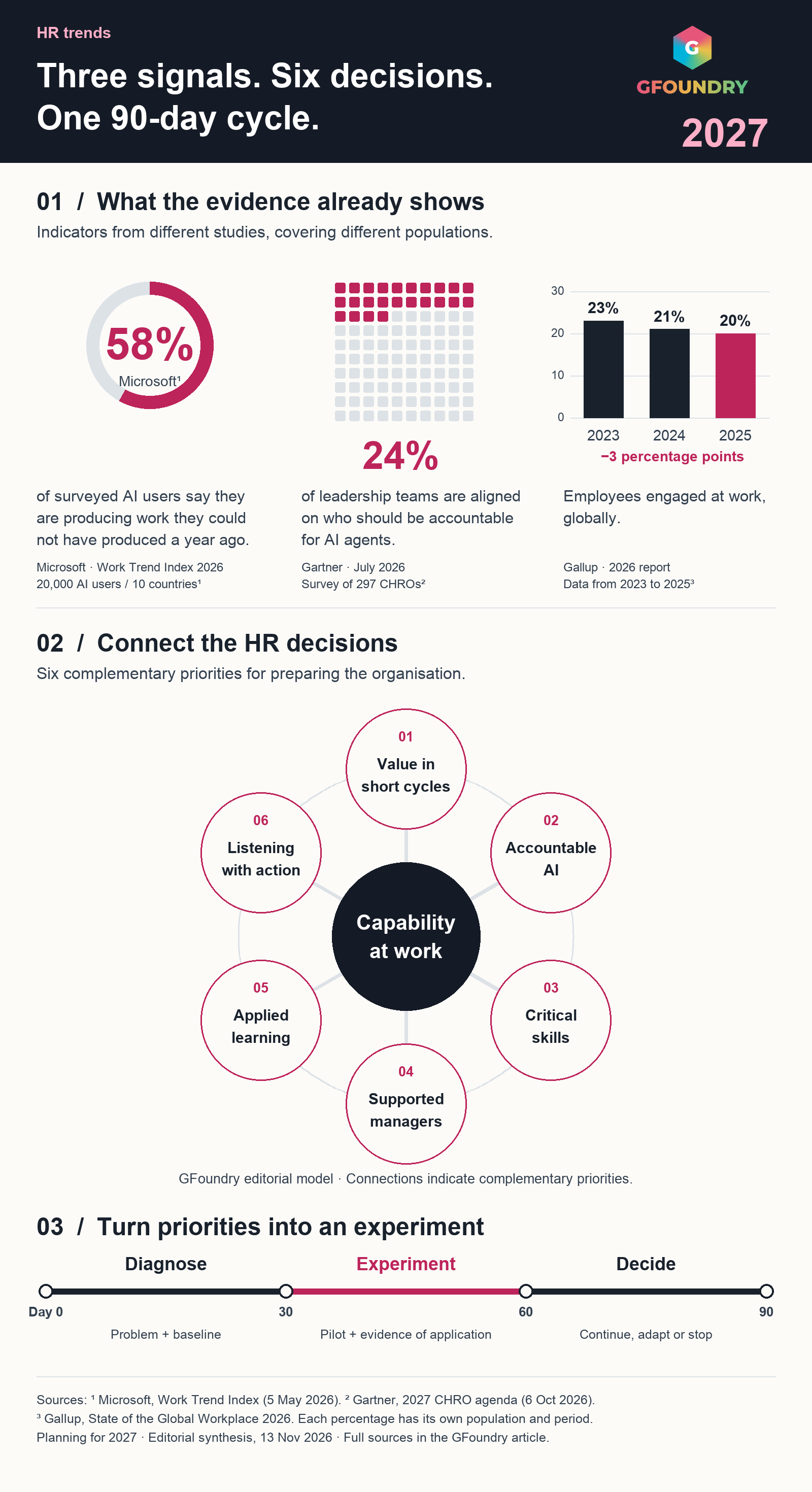
Our selection connects six priorities: delivering value in short cycles, clarifying human accountability for AI, developing critical skills, supporting managers, integrating learning into work and acting on employee feedback. Their order supports the narrative; each organisation should set its own sequence around the problems it needs to solve.
1. Deliver value in short cycles
Gartner’s 2027 CHRO agenda, presented in October 2026, highlights speed to value. Our planning recommendation is to start with a clearly bounded problem, an observable outcome and an accountable owner.
Consider a company trying to improve onboarding. “Digitise induction” is too broad to guide a first cycle. A more useful starting point would be to ensure that each person receives the instructions they need before their first shift and knows who can help. The organisation can observe whether this happens, identify difficulties and decide what to change.
The same approach applies to learning, feedback and recognition. Before configuring an initiative, describe who should benefit, which behaviour it should support and what evidence will help assess the experience. Combine a usage measure with a measure of the underlying problem: people who completed an activity and people who can carry out the task that activity addresses.
Decision for 2027: choose one priority use case and a first verifiable outcome. Indicators: time to that outcome, reported difficulties and support required. Agree in advance when the initiative should continue, change or end. A short cycle should also make it possible to stop pursuing an assumption that did not work.
2. Clarify human accountability for AI
Gartner includes human accountability for AI agents among its 2027 priorities. Microsoft’s 2026 Work Trend Index also connects AI adoption with work design. Its survey covered 20,000 workers using AI across ten countries; that sample does not represent all workers or Portugal specifically.
For HR, the practical decision is to identify tasks where AI can help and the points where a person must check, decide and take responsibility for the result. A draft training resource, for example, may require review by someone who knows the internal process. That review should cover accuracy, context, language and suitability for the intended audience.
Map a simple workflow: what information goes in, what output is expected, who checks it and what happens when there is uncertainty or an error. Define an alternative when the tool is unavailable. For decisions affecting people, involve the appropriate specialists to assess the data, purpose and conditions relevant to each use case.
Decision for 2027: document one AI-assisted workflow and assign responsibility for every stage. Indicators: errors identified, corrective work, review time and final output quality. Measuring production speed alone can hide costs that emerge later when someone else has to repair the output.
3. Connect critical skills to real opportunities
Another Gartner priority is to focus development on the skills that differentiate the organisation. Our recommendation is to connect each selected skill to concrete work: a task, project, responsibility or internal mobility opportunity.
An extensive skills list can organise information, but it only guides decisions when people understand what each proficiency level means. “Communication”, for example, needs context. Explaining a procedure to a colleague, handling a difficult conversation and presenting a proposal to a client require different evidence.
Start with one job family and involve people who know the work. Select a few priority skills, describe observable behaviours and agree how evidence will be gathered. Self-assessment can start a conversation; observing a task, reviewing a work sample or considering contextual feedback can help substantiate it.
Then create opportunities to practise: shadowing a colleague, joining a project or taking on a task with support. Employees should understand how to access those opportunities and which criteria apply. Our article on operationalising a skills-based talent strategy explores the connection between development and internal mobility.
Decision for 2027: test a limited set of skills in one area. Indicators: application at work, evidence quality and access to development opportunities. Revisit the criteria when two managers interpret the same proficiency level very differently.
4. Give managers the conditions to lead change
Leadership execution is the fourth priority in Gartner’s agenda. For an organisation, this raises a capacity question: what time, authority and support do managers have to guide the changes expected of them?
A new programme can add meetings, approvals and information requests to the schedule of someone already coordinating daily work. If those activities lack a clear purpose, the programme can become difficult to sustain. Preparation should include a discussion about what is no longer needed, what can be simplified and which decisions managers can make themselves.
In a development cycle, for example, prepare managers to discuss evidence, clarify expectations and agree a next step. Give them conversation examples, shared criteria and a way to request help with difficult situations. Test the process with managers in different contexts, including shift-based or distributed teams where relevant.
Decision for 2027: include the manager experience in the pilot of any talent programme. Indicators: obstacles resolved, perceived conversation quality and time required to support the process. Form completion is useful information, but it should be interpreted alongside the quality of support that employees received.
5. Integrate learning, practice and feedback into work
Deloitte’s 2026 Human Capital Trends analysis highlights continuous learning, feedback and support during adaptation. Microsoft also explores organisations’ capacity to learn from work in its 2026 report.
A practical application is to design a sequence that starts with a real task. Imagine a team that needs to improve its response to complaints. A short resource can explain the procedure, a simulation allows people to rehearse the conversation and feedback helps identify what went well and what needs to change. A further application shows whether the person transferred what they learned.
The format should reflect the difficulty. A brief instruction may resolve a simple question; a task requiring judgement may need supported practice, discussion and several attempts. Set aside time to learn and check that materials are accessible in the context where people work.
Decision for 2027: redesign one pathway around a task and evidence of application. Indicators: performance on that task, recurring errors and support still needed after practice. Course completions and quiz results help monitor the pathway, but judging effectiveness requires observing the work that the learning is intended to support.
6. Make employee listening lead to action
Gallup’s State of the Global Workplace 2026 reports that 20% of employees globally were engaged at work in 2025. The report was published in April 2026, using data collected from January to December 2025. This is a global indicator, with no automatic equivalence to an individual company or Portugal.
For 2027 planning, we recommend treating listening as a cycle with a visible response. Before launching a survey, clarify which decision its answers can inform, who will follow it through and when employees will hear what happened.
If a team reports difficulty understanding priorities, the next step might be to test an alignment routine and then ask whether the difficulty has decreased. Communicate what was heard, what was selected for action and what cannot yet be resolved. This feedback gives participation context and creates space to discuss real constraints.
Decision for 2027: connect every listening cycle to an action and a date for reporting back. Indicators: completed actions, perceived responsiveness and changes in the selected problem. Also examine who can participate. Establish appropriate confidentiality and aggregation conditions, particularly where teams are small.
Infographic: six priorities for 2027 planning
What organisations in Portugal should consider
The European Commission’s 2026 Digital Decade report for Portugal identifies strong connectivity alongside challenges in enterprise adoption of AI and cloud services, and in basic digital skills.
Our editorial implication for HR is to assess people’s ability to participate before launching an initiative. Having a tool available and being able to use it at work are conditions worth checking separately. Look at device access, available time, language, confidence and nearby support.
In an organisation spanning offices, stores and operations, the same pathway may need different access methods and participation windows. Test with people who represent that diversity. Pilot findings should help adapt the programme; a volunteer team with high digital confidence can leave important difficulties undiscovered.
Turn the trends into a 90-day plan
The following plan is a suggested sequence that you can adapt. Choose one initial priority, establish a baseline and agree a decision at the end of the period. The timeline organises the team’s learning; some outcomes, such as retention or career progression, require longer follow-up.
| Period | Purpose | Work to do | Evidence | Decision |
|---|---|---|---|---|
| Days 1–30 | Diagnose | Choose the problem, listen to participants, assign an owner and define an indicator. | Baseline, difficulties and access conditions. | Which assumption is worth testing? |
| Days 31–60 | Experiment | Test with a defined group and follow application in the work itself. | Usage, quality, feedback and effort required. | What needs to change? |
| Days 61–90 | Decide | Compare with the baseline, document limitations and report back. | Observed outcomes, costs and remaining risks. | Continue, adapt, expand or stop? |
Download the editable HR priorities 2027 checklist (CSV). The file opens in Excel or Google Sheets, with one row per priority and fields for owner, indicator, baseline, target, deadline, evidence, risk and decision. Measurement fields are blank so you can enter your organisation’s own data.
When interpreting the pilot, record other changes that may have influenced the outcome: team composition, workload, seasonality or additional support. An observed improvement is a signal to investigate; a before-and-after comparison alone does not show that the programme caused the entire change.
What these priorities require from a talent platform
When a priority requires technology, take a concrete scenario to the demonstration. Ask to walk through the experience of an employee, a manager and an administrator, including how the outcome is monitored. Check configuration work, necessary integrations, permissions and the conditions of each plan.
Use our guide to choosing a talent management platform and its decision matrix to structure that assessment. To explore an application in GFoundry, review the learning, performance and engagement modules and select those relevant to your use case. Performance evaluation and career management are available on the Premium plan.
Sources and limitations
The selection of trends and the 90-day plan are GFoundry’s editorial synthesis. The sources below support the context; they do not constitute a statistical forecast for 2027. International studies cover different populations, periods and methodologies, so their indicators should not be combined into a ranking or treated as a diagnosis of your company.
- Gartner — CHRO priorities for 2027, 6 October 2026.
- Microsoft — Work Trend Index 2026, 5 May 2026.
- Deloitte — Human Capital Trends 2026, 4 March 2026.
- Gallup — State of the Global Workplace 2026, global data, published in April 2026, using 2025 data.
- European Commission — Portugal, Digital Decade 2026, page updated on 24 August 2026.