
On 20 October 2026, João Carvalho of GFoundry and Cláudia Batista of Moxie Humans led the “From evaluation to decision” workshop. It took place in Lisbon as part of Global Talent Day, an event for HR professionals organised by iiRH.
The starting question was this: what do we really need to know before making a decision about someone?
The exercise introduced Nuno, Carla and Bruno, three fictional employees. All had already been through evaluations, feedback and other talent processes. There was no shortage of records. The question was whether the information reaching the decision was sufficient. The names and figures were illustrative.
First, the exercise presented each person’s role, tenure, evaluation and manager’s view. The invitation was to choose between retaining, developing or letting the person go — and indicate how confident you were in that choice.
Then, in the Talent Insights demonstration, those records were connected with the business and each person’s work. Let us follow that journey: the initial picture, what bringing the information together adds, and the questions that then become relevant.
Nuno: “Things are going very well”
Nuno is a specialist salesperson and has been with the organisation for 12 years. He exceeds expectations and achieved 102% of his targets. His manager says: “Things are going very well. He does not need anything.”
If we stopped here, would there be any reason to give him more attention?
Nuno Antunes
- 1. Before: the initial picture
- 3.62 · “Exceeds expectations”. 2025 target attainment: 102%.
- “Things are going very well. He does not need anything.”
- 2. What was already recorded
- After changing roles, he moved from the bottom 25% of evaluations to the top 10%.
- Critical role with no named successor. Development plan not updated since March, with two overdue actions.
- 3. After: with the business context
- Sales above target, but with more discounts and complaints.
- The store closes 27% of bespoke projects in weeks when he is present, versus 22% in weeks when he is absent. The association does not demonstrate causality.
Nuno: could the store be very dependent on him? Which signals need to be clarified?
Bringing the information together opens conversations the rating did not resolve. One concerns sales quality: meeting a target can coexist with greater discounts and more complaints. Another concerns continuity in the role. The change of role helps explain how the evaluation evolved; the lack of a successor and the outdated plan show that good performance also needs follow-up.
The contrast between weeks of presence and absence makes the store’s dependence on Nuno a hypothesis to explore. It does not demonstrate that Nuno alone causes the difference: demand, the team and the type of project may also vary. Those conditions need to be checked before attributing the result to the person.
We therefore move from “he does not need anything” to questions about the support he needs, how results are changing and the knowledge that should be shared. None of this reveals an intention to leave. The organisation’s dependence and the person’s intentions require different conversations.
Carla: “She does not yet have the profile to lead”
Carla is a salesperson who joined the organisation in April 2025. Her evaluation says “Meets expectations”. Her manager’s view is: “She meets expectations. She does not yet have the profile to lead.”
What information would we be missing before accepting this view of her future?
Carla Mendes
- 1. Before: the initial picture
- 3.12 · “Meets expectations”. 2025 target attainment: 101%.
- “She meets expectations. She does not yet have the profile to lead.”
- 2. What was already recorded
- Recognition from 20 colleagues in 2026, versus two in 2025. Peers: 4.4/5; manager: 3.1.
- Fewer points, with platform use unchanged. Four training courses in 2025; the 2026 plan is halfway through.
- 3. After: with the business context
- Fewer transactions per hour than the team. Almost half of her sales are bespoke projects: twice the team’s proportion.
- Colleagues on her shifts moved from 24% to 33% of projects closed; the others remained at 25%.
Carla: could she be making a contribution to the team that goes unseen and cannot be captured in an individual rating?
The recognition and feedback records already existed. When read alongside the type of sale and her colleagues’ work, the transaction count is no longer enough to compare performance. Sales of different complexity may take different amounts of time. Likewise, platform points describe a specific activity; they are not a direct measure of merit.
The difference between the peers’ view and the manager’s view calls for examples, investigation and calibration. Does Carla help prepare proposals? Does she pass on knowledge? Does she support colleagues with complex sales? The change across shifts gives a concrete reason to investigate, but does not isolate its cause or establish leadership potential on its own.
Carla’s own perspective is also missing. She may want to lead people, deepen a specialism or take on a different kind of responsibility. Making her contribution more visible helps prepare the development conversation; it does not choose her career for her.
Bruno: “He is one of us. He has always delivered”
Bruno has been with the organisation for 18 years. His rating has remained at “Meets expectations” for four cycles. “He is one of us. He has always delivered,” says his manager.
Is a stable evaluation enough to know whether the situation is still the same?
Bruno Lopes
- 1. Before: the initial picture
- 2.58 · “Meets expectations”. The same evaluation over the past four cycles.
- “He is one of us. He has always delivered.”
- 2. What was already recorded
- Target attainment fell from 98% to 54%, while the rating stayed unchanged.
- Training plans marked complete, but the decline continued. Critical role with no successor.
- 3. After: with the business context
- Store at 93% of its targets; other stores at 101%. None of the three training modules for the new stock system completed.
- Team hours 12% above plan, versus 5% in other stores, and more products missing from the shelves.
Bruno: a stable rating for someone we have known for a long time can conceal results that are deteriorating.
Here, the history helps distinguish two things the rating seemed to bring together: knowing someone for a long time and knowing how they are working now. Individual target attainment and store indicators are separate measures. Their trends should be considered together, without merging them into a single judgement about Bruno.
The plan’s “complete” status also needs checking. What training was actually completed? What preparation was missing for using the new system? The gap between the record and the modules completed makes the learning conversation concrete; the increase in team hours and the gaps on the shelves call for investigation into obstacles and operating conditions.
Tenure does not explain current performance. Nor do the indicators prove individual negligence. Before deciding, expectations need clarifying, the support provided needs checking, and actions that can be followed up need agreeing, such as specific training and a revised plan. The critical nature of the role calls for continuity planning; it does not justify an automatic decision to let someone go.
From evaluation to decision with Talent Insights
In all three cases, the evaluation, feedback and development processes predate the analysis. The information existed, but some of it did not reach the conversation or was consulted in isolation. The exercise shows what changes when we connect those records with the work being done and business results. It does not demonstrate that more information produces better decisions on its own.
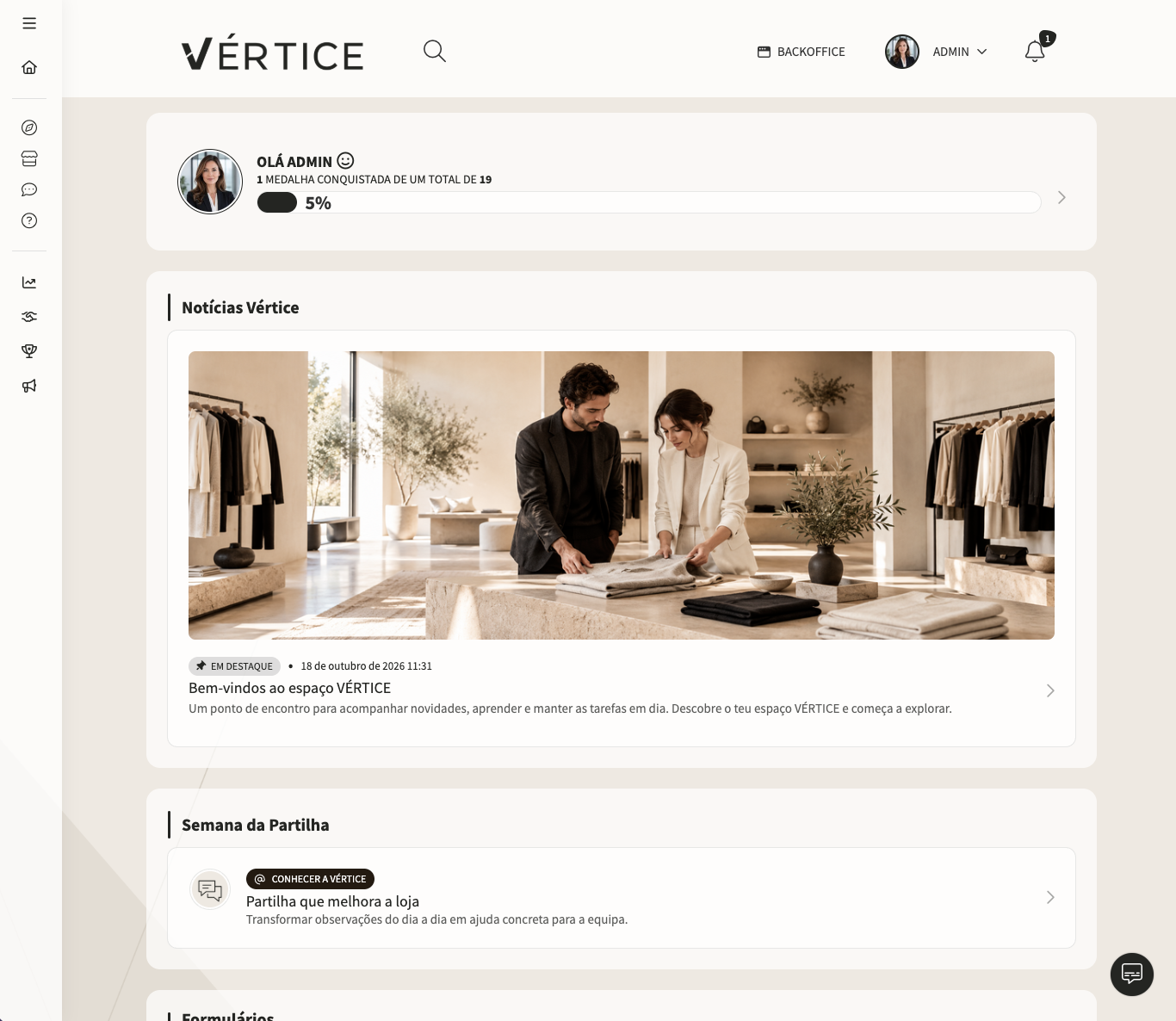
The three scenarios were built in Vértice, a fictional GFoundry demonstration environment whose home page is shown below.
The connection between evaluation, development and follow-up is part of GFoundry’s Performance Evaluation and Career Management solution. Within GFoundry Intelligence, People Intelligence presents Insights computed by the platform; AI agents are separate tools. Talent Insights on an individual profile bring together individual context and state their limits. They do not predict whether an individual will leave.
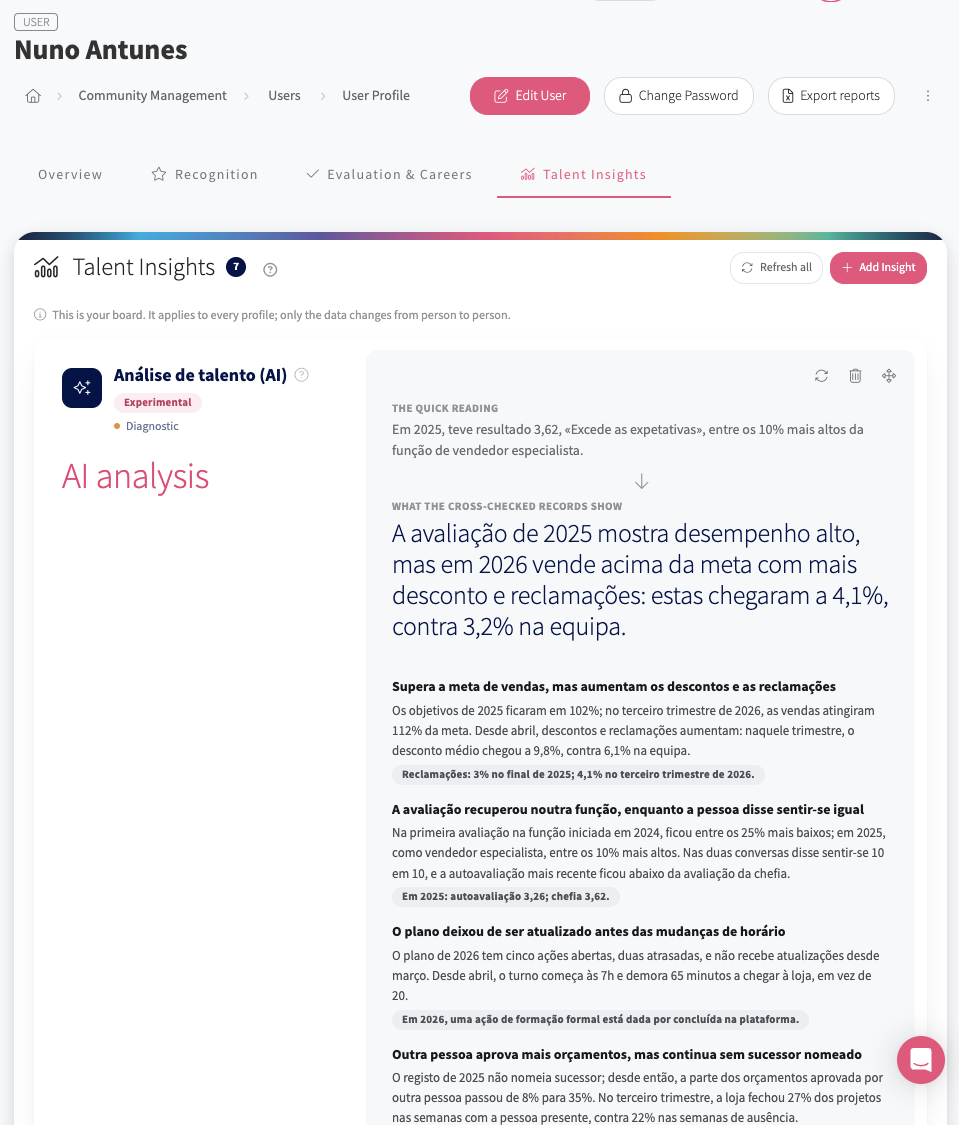
In the screenshot, Nuno’s previous evaluation appears as the initial picture; the experimental analysis then connects it with other records in the scenario. The service is not the source of the evaluation, feedback or plans. The demonstration explores relationships and contradictions that a consultation in isolation may miss.
It is always the client who decides whether to share business or other operational data with GFoundry, and which data to make available. The platform can receive that data, store it securely and process it, connecting it with talent information to produce insights.
This capability does not mean automatic access to the client’s systems. Data provision and the corresponding integration are defined with the organisation and depend on configuration, permissions and the relevance of each source. The sources still need checking, and the person still needs to be heard.
Measuring activity is not enough to understand contribution
Having data in different systems does not guarantee that it is up to date, comparable or brought into the conversation meaningfully. Before interpreting a signal, we need to distinguish what we observe from what we still need to understand.
| What we observe | What we still need to understand |
|---|---|
| A high evaluation | How have results, development and continuity in the role evolved? |
| More recognition or fewer points | Which behaviours are recorded, and which contributions sit outside the platform? |
| A stable rating | Do the criteria, targets and working conditions still support that view? |
An indicator that is easy to count can become a poor substitute for what we actually need to understand. Points, hours, clicks or completed training describe specific activities or records. Their interpretation depends on the role, access, opportunities and the purpose for which they were created.
Comparing people or teams means asking whether we are looking at equivalent periods, similar work and comparable conditions. Greater numerical precision does not fix a poorly constructed comparison. Bringing information together is only useful when it clarifies the decision in front of us.
Before the next decision, make clear what is still missing
The exercise can be brought into a real meeting without starting by buying more tools. Choose a specific decision and work through five steps:
- Define the decision. Preparing a succession, reviewing a development plan and understanding a drop in results require different information.
- Separate observations from interpretations. “The plan has two overdue actions” describes a record. “The person has lost motivation” is a hypothesis that needs confirmation.
- Check the information. Identify the source, period, update, gaps and conditions for comparison. Use only data that is relevant and appropriate to the purpose.
- Listen to the person. Present the signals clearly, ask for context and discuss expectations, obstacles and ambitions. The missing information may not be in any system.
- Agree the follow-up. Record the action, who owns it, when it will be reviewed and what will help establish whether progress has been made.
The documentation on People Intelligence limits is explicit: Insights inform human decisions and do not determine promotions, pay, evaluations or departures. A diagnostic or experimental reading is not sufficient on its own to make a decision about someone.
Taking care with context includes knowing where to stop. Schedules, commutes or other personal circumstances should not be turned into indicators of intentions or commitment. The availability of data does not establish a need to use it.
The better question may change before the decision does
What do we really need to know before making a decision about someone? The exercise ends without a definitive answer about Nuno, Carla or Bruno. What it offers is a way to recognise what the initial picture left out and prepare questions that need clarifying.
That is why the workshop script returns to the initial choice and the confidence in it. More information may reveal uncertainties we could not previously see. Changing a choice does not prove the new decision is better; recognising those uncertainties should lead to checking, conversation and follow-up.
If you would like to explore how to connect evaluation, development and context in your organisation, you can request a GFoundry demonstration.