
 The Foundation of Talent Management: Step Zero
Organizational culture is not a poetic abstraction that survives in manifestos pinned to office walls. On the contrary, it is a living ecosystem of behaviors, decisions and mappable competencies that, when supported by the right technology, turn into daily high-performance rituals. For Chief Human Resources Officers (CHROs) and business leaders, the contemporary challenge lies not only in attracting people, but in ensuring that human capital is intrinsically aligned with the company’s genetic code.
Before designing any attraction, retention or development program, it is imperative to go back to basics. We need to define talent in its purest and most actionable essence:
Talent is the set of aptitudes, whether natural or acquired, that condition success in a given activity and determine an individual’s ability to generate sustainable value for the organization.
The Critical Cornerstone of HR Strategy
Many organizations fail in their people strategies because they try to build the roof before the foundations. The first and most critical step – the true Step Zero – of any Human Resources strategy is the rigorous identification of key competencies and values. Without this clarification, it is virtually impossible to attract the right profiles, evaluate performance fairly or develop career plans that make sense for the business.
Demystifying organizational culture requires us to treat it as a behavioral science. It is not an ethereal concept, but rather a set of developable and measurable attitudes. This is where technology takes on a transformative role. The GFoundry platform positions itself as the digital ecosystem that allows you to map, tangibilize and ritualize this organizational DNA from the employee’s very first day of integration, ensuring that theory converts into daily, observable practice.
The Competencies and Values Matrix: Practical Examples
Identifying values is only the beginning of the journey; the true test of an organization’s maturity lies in its ability to translate those abstract values into observable and actionable behaviors. When an employee understands exactly what is expected of them in practice, ambiguity disappears, giving way to focused execution aligned with strategic objectives.
To illustrate this translation process, let us consider a fundamental competency matrix. This matrix serves as a compass for performance evaluation, recruitment and the identification of high potential within teams. According to McKinsey & Company, organizations that define clear, observable behaviors for their values are significantly more likely to sustain an agile, resilient culture in the face of market fluctuations.
Deconstructing Organizational DNA
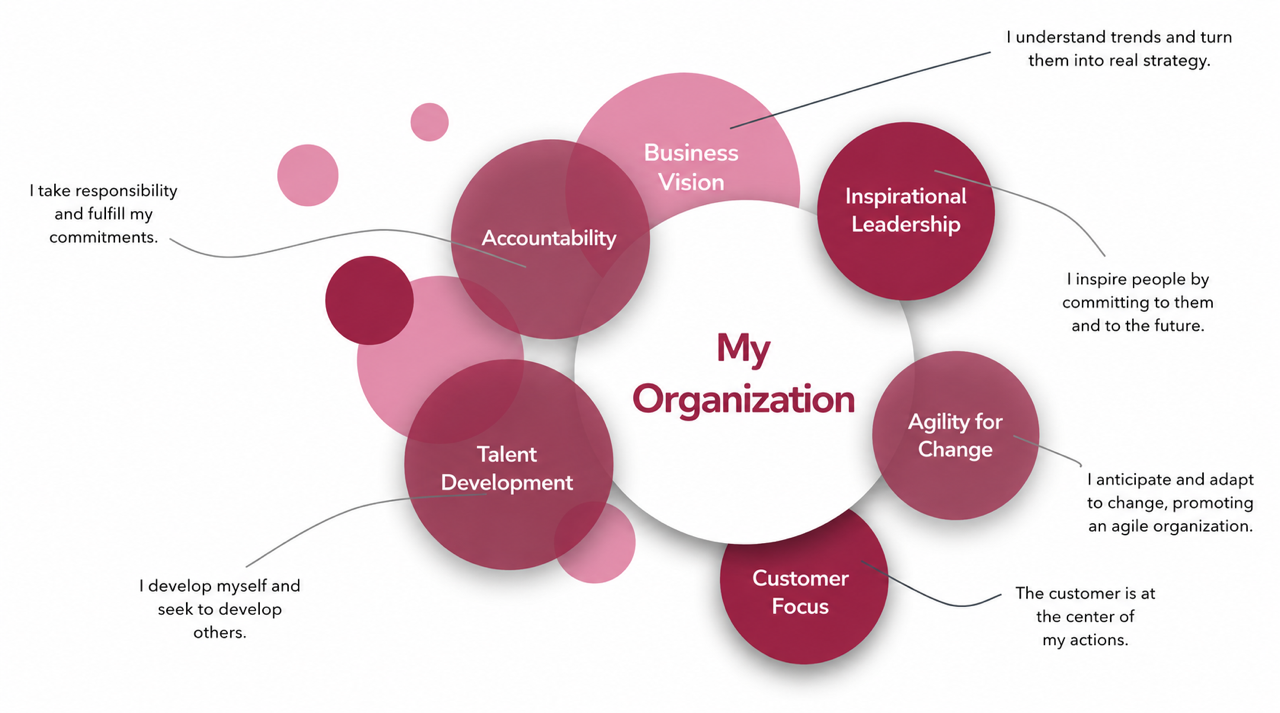
Let us look at how four classic pillars of corporate culture can be deconstructed into daily actions that any manager can observe, measure and reward:
- Business Acumen: Knowing the product is not enough; it requires the ability to read market trends and turn the macro strategy into operational reality within one’s sphere of influence.
- Inspirational Leadership and Accountability: True leadership is not a job title, it is a behavior. It involves inspiring people and committing them to the company’s future, while taking full responsibility for failures and honoring the commitments made.
- Talent Development: The ongoing commitment to developing oneself (upskilling) and the proactivity to develop others around you, acting as an informal mentor.
- Customer Focus and Agility for Change: Placing the customer at the center of every action, anticipating needs and adapting quickly to change to foster a truly agile organization.
This matrix is not a static document; it is the engine that should fuel all of the organization’s evaluations, feedback and training plans, ensuring that talent is measured by the same yardstick across every department.
GFoundry structures this matrix through a 4-level hierarchy that links each role to the concrete competencies expected. Everything is configurable in the backoffice, with no code:
Evaluation cycles are available in 4 configurable models: Self-assessment, Top-Down, 360° Feedback and Objective-based Evaluation. An organization can, for example, use 360° for leadership roles and Top-Down for operational functions, within the same cycle, with distinct weights and criteria per group.
The results of each cycle automatically feed the Individual Development Plan (IDP), structured according to the 70-20-10 methodology: 70% learning through on-the-job experience, 20% via feedback and peer mentoring, 10% formal training, ensuring that development is not confined to the training room.
 From Paper to Practice: Competency Mapping
The greatest risk in talent management is allowing the identification of values and competencies to die in the welcome handbook. A static document, handed over on the first day of work and forgotten in a digital drawer, has no power to shape behaviors or drive performance. For the company’s DNA to come alive, it is imperative to move from paper to practice through dynamic, technology-supported Competency Mapping.
The Holistic View of the Employee
Operationalizing this matrix requires the platform to turn every employee interaction into a measurable signal. At GFoundry, this mechanism is called Skills Taxonomy, a dynamic engine that assigns competencies to each employee automatically, with no manual intervention, based on three distinct and complementary sources:
- Training (Learn module): Each piece of content in the library — article, video, quiz, presentation — can be tagged by the admin with one or more competencies. When an employee completes that content with meaningful interaction (watching the video to the end, answering the quiz correctly, going through the slides within the minimum required time), the platform records the signal and reinforces that competency in their profile. Simply opening content without interacting assigns no competency.
- Peer Recognition (Recognition module): When a colleague endorses a Soft Skill (e.g. “Empathy”, “Assertive communication”) or a Hard Skill (e.g. “Data analysis”, “Project management”) on another employee’s profile, this signal automatically enriches that person’s competency map. Peer-to-peer recognition stops being a symbolic gesture and becomes structured organizational intelligence.
- Performance Evaluations (Evaluation & Careers module): The results of evaluation cycles (Self-assessments, 360° or Top-Down) reinforce and consolidate the profile, adding the dimension of direct observation by the manager and close peers.
The combination of these three sources generates a truly holistic 360° Profile for each employee, consolidating training, recognition and evaluation into a single, continuous view. Competency mapping stops being an annual snapshot taken in a calibration meeting and becomes a real-time film that reflects the evolution of talent as it happens, week by week, interaction by interaction.
GFoundry allows the CHRO and HR managers to visualize, in real time, which competencies are most and least developed in each team or department. If the quarter’s strategy calls for reinforcement in “Assertive communication” or “Stress management”, the platform immediately identifies:
Note: The admin configures the skill tags on content and evaluations. From there, the Skills Taxonomy engine operates automatically, with no manual assignment of competencies to individual profiles.
Gi Talent: From Gap to Predictive Behavior
Competency mapping is the cornerstone, but GFoundry goes further with the artificial intelligence layer Gi Talent. This feature analyzes behavioral patterns over time and classifies each employee into one of 9 dynamic profiles, from “Emerging Talent with Leadership Potential” to “Overloaded Employee” or “Employee at Risk of Leaving”. When an employee’s profile changes, the platform generates an automatic alert for the manager, accompanied by a personalized coaching script with recommended actions for that specific situation.
In the Talent Dashboard, the most strategic view is the 9-Box Matrix, which positions each employee on two axes: current performance vs. future potential. This matrix stops being a subjective exercise done once a year in a meeting room. At GFoundry it is fed continuously by real platform data, making talent calibration conversations faster, more factual and less dependent on each manager’s individual perception.
For CHROs, combining the Skill Coverage Heatmap with Gi Talent transforms decision-making: instead of allocating people based on who speaks up most, they allocate based on who continuously and measurably demonstrates the right competencies.
The Next Cycle: How Values Dictate Solutions
Identifying and mapping competencies (Step 1) is fundamental, but it is not an end in itself. It is the launchpad for Step 2 of talent management: designing practical solutions for attraction, retention and continuous development. It is crucial to understand that this second step can only advance effectively after the first is absolutely consolidated. Trying to implement training programs or reward systems without a clear competency map is the equivalent of navigating without a compass.
As industry analyst Josh Bersin notes, the most mature organizations are transitioning to skills-based organizations, where every HR initiative is rigorously framed and justified by the previously mapped values and competencies. This ensures there is no waste of resources on generic training that does not serve the strategic purpose of the business.
Gamification: Turning Values into Missions
It is in the operationalization phase that technology demonstrates its true value. Take the key competency “Customer Focus” as an example. Instead of approaching it through a tedious traditional e-learning module, GFoundry makes it possible to turn this competency into an interactive Mission. On the platform, “Customer Focus” can be conceptualized as a planet to conquer within a gamified journey.
Missions in GFoundry are structured into Milestones (main stages) and Goals (concrete, trackable actions). Each Goal has a different type — learning content, quiz, recognition, form, pulse survey — and can combine distinct platform modules into a cohesive journey. Here is what the “Customer Focus” Mission would look like in concrete terms:
In the GFoundry backoffice, the admin creates the badges associated with this mission and defines the triggers that activate them automatically. Each trigger is a specific user action that, once completed, fires the awarding of the badge with the corresponding points and virtual coins:
This gamified approach not only fosters continuous learning in an engaging way, but also closes the loop between training, observed behavior and recognition. By tying real game mechanics (badges with concrete triggers, virtual coins with value in the Marketplace, competency-based leaderboards) to the company’s values, HR solutions stop being perceived as bureaucratic obligations and become experiences of growth and recognition, seamlessly integrated into the employee’s everyday work.
 Conclusion: Toward Behavioral Ritualization
Identifying, defining and mapping competencies is only the beginning of the talent management journey. The true triumph of a Human Resources strategy is not measured by the quality of its guiding documents, but rather by its ability to generate Behavioral Ritualization. This is the ultimate goal: ensuring that the values identified on paper come to be felt, lived and repeated daily by employees, turning into a deeply rooted organizational habit.
When ritualization occurs, culture no longer needs to be policed. High-performance behaviors, empathy, innovation and customer focus become the team’s natural way of acting. However, for this organic transformation to happen at scale, especially in hybrid or remote work models, consistency is essential. A technological engine is needed to sustain these rituals, to remind, to reward and to measure the continuous evolution of each individual.
The transition from a competency map to true behavioral ritualization requires technology that integrates learning and performance into everyday work. GFoundry materializes this challenge, turning talent management into a dynamic ecosystem where the Skills Taxonomy feeds the Talent Dashboard, gamified Missions reinforce values on the ground, and Gi Talent anticipates risks before they become problems. For leaders, this means abandoning isolated processes and adopting an integrated vision that links development to business objectives. Discover how to operationalize the DNA of your talent and request a demonstration of the platform.