
The new EU directive will require greater clarity about pay. For employers, preparing means much more than disclosing salaries: it means looking at roles, career paths and how decisions are made and explained.
Pay transparency will make it harder to sidestep a question many organisations still struggle to answer clearly: why are people doing the same work or work of equal value paid differently?
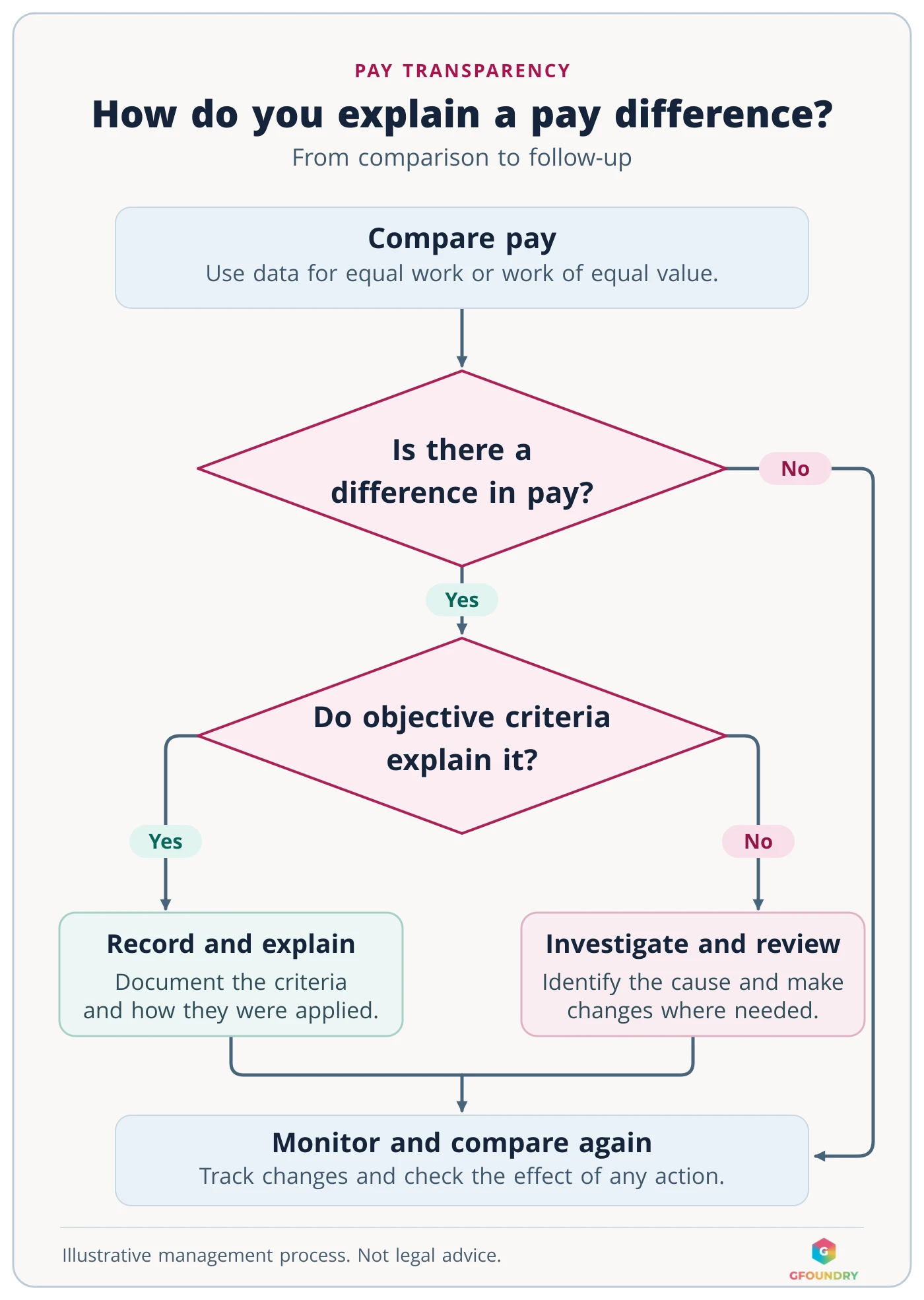
A difference does not necessarily mean discrimination. But explaining it takes more than pointing to the market, merit or a past negotiation. Employers need to understand how they value work and how they apply their criteria.
This is the context for Directive (EU) 2023/970. Its aim is to strengthen equal pay between women and men through information, transparency and accountability mechanisms. It is not just an administrative change. It tests how consistently an organisation manages its people.
What are the new pay transparency rules?
The EU directive seeks to make an existing principle effective: equal pay for equal work or work of equal value.
It increases the information available before hiring and during employment, sets reporting obligations for certain organisations and provides mechanisms for reviewing and correcting pay differences. It also includes protections and remedies for people who experience discrimination. Council of the European Union: pay transparency.
The changes include giving job applicants information about starting pay or its range, prohibiting questions about pay history and granting workers rights to access pay information.
This does not mean publishing a list of everyone’s individual salary. The aim is to make meaningful comparisons possible and allow the criteria to be scrutinised while protecting personal data.
The EU timetable
The transposition deadline was 7 June 2026. Periodic reporting follows a phased timetable:
On small screens, scroll horizontally to view all columns.
| Employer size | First report | Frequency thereafter |
|---|---|---|
| 250 or more workers | By 7 June 2027 | Annually |
| 150 to 249 workers | By 7 June 2027 | Every three years |
| 100 to 149 workers | By 7 June 2031 | Every three years |
Reports cover the previous calendar year. Member States may set additional requirements, including for smaller employers. Not having to report periodically does not exempt an employer from the other applicable rules. Directive (EU) 2023/970, Articles 9 and 34.
That is why saying “the new rules take effect in 2027” oversimplifies matters: it conflates the transposition deadline, national implementation and the first reporting deadline for certain employers.
Where does Portugal stand?
Portugal already has equal pay legislation. Law No. 60/2018 provides for a transparent pay policy based on assessing the components of roles against objective criteria that apply equally to women and men. The need to justify pay therefore did not begin with the new directive. Law No. 60/2018, Article 4 (Portuguese).
A draft to transpose the directive was published for public consultation. According to a report by ECO on 12 November 2026, the proposal was still awaiting approval by the Council of Ministers before being sent to Parliament.
It is important not to present the options in that draft as enacted legislation. Organisations should follow the final text and the applicable national deadlines. Draft published in Portugal’s Labour and Employment Bulletin (Portuguese); ECO, 12 November 2026 (Portuguese).
Preparation does not need to wait, however. Understanding roles, organising data and reviewing criteria are useful regardless of the final transposition details.
The problem starts before payroll
In many companies, pay reflects decisions that have accumulated over the years.
One hire was made in a more competitive market. One person negotiated a better starting salary. Another accepted a counteroffer to stay. One team had the budget for pay rises and another did not. Some responsibilities expanded without any formal change to the role.
None of these situations should be judged without context. But over time, exceptions can add up to a structure that no one can explain consistently.
Transparency makes that weakness more visible. The question is no longer just “can we calculate the difference?” It becomes “do we understand the decisions that led to it?” This is where pay transparency becomes a people management challenge, not just a payroll exercise.
1. Roles: understand the work before comparing pay
A meaningful comparison requires knowing what people actually do.
Identical job titles can conceal different responsibilities. Different titles can refer to work of equal value. An outdated job description may omit responsibilities that have become part of the day-to-day work.
Job evaluation examines those demands rather than rating the person who holds the role. EIGE’s European toolkit proposes a gender-neutral approach that considers skills, effort, responsibility and working conditions. EIGE: job evaluation and classification.
In practice, this is a reason to review the company’s job architecture:
- Are responsibilities clear enough?
- Do levels reflect real differences in complexity and autonomy?
- Is the same work described in comparable terms across departments?
- Are relevant demands routinely overlooked or undervalued?
Without this foundation, even a technically correct pay analysis may rest on poorly defined comparisons.
2. Careers: make the path to progression visible
Pay transparency also brings a common employee question into sharper focus: what do I need to demonstrate to progress?
If the answer depends mainly on the manager, the person’s negotiating skills or an informal opportunity, the organisation will struggle to explain whether it makes decisions consistently.
A clearer career framework distinguishes, for example, between:
- development within a role;
- moving to a level of greater complexity;
- changing roles;
- taking on leadership responsibilities.
These situations are not equivalent and need not follow the same pay logic.
What matters is that people understand the path, the relevant criteria and how decisions are made. Having criteria does not mean promising automatic pay rises. It means narrowing the gap between what the company says it values and what it actually rewards.
3. Decisions: replace vague explanations with verifiable reasons
Phrases such as “they have more potential”, “the role is more strategic” or “the market pays more” may convey relevant information. They may also conceal poorly defined criteria.
A better-supported decision identifies what was considered, why it matters and how it compares with similar situations.
If performance influences pay, the objectives and evaluation criteria need to be clear. If a promotion depends on particular skills, it may be useful to gather evidence through work experience, structured interviews or suitable assessments.
These tools are a means to an end. The directive does not universally require an annual performance review or make any particular assessment model mandatory.
The key is not to confuse documentation with quality: a decision recorded in a system may still be inconsistent. The process should allow these inconsistencies to be identified and reviewed.
4. Communication: prepare for conversations, not just paperwork
Transparency can prompt difficult questions even in a company acting in good faith.
Why was someone hired at a higher rate of pay? Why was there a promotion in one team but not another? Why has someone been at the same point in their pay band for several years?
A company-wide presentation on pay policy is not enough to answer such questions. HR teams and managers need to be prepared for specific conversations without giving contradictory answers or making promises they cannot keep.
Useful communication should explain:
- the criteria used;
- the limits of what can be shared;
- how to ask for clarification;
- how cases requiring review are examined;
- what happens when an inconsistency is identified.
The aim is not to eliminate all disagreement. It is to ensure there is a clear, credible process for addressing it.
5. Development: give people a fair chance to progress
Setting progression criteria is not enough if access to development opportunities is unequal.
If particular skills are valued, it is worth asking who has the opportunity to develop them. Who is assigned the more visible projects? Who has access to mentoring? Who takes part in initiatives that open a route to promotion?
A company can apply the same evaluation framework to everyone and still offer people very different opportunities.
Connecting career progression and development helps address this issue. The criteria no longer serve only to explain past decisions. They start to guide action: what experience to gain, which skills to develop and which responsibilities to prepare for.
Transparency becomes more useful when it shows not only where a person stands but also the paths they can take.
6. Trust: consistency matters more than the amount of information
Publishing more information does not automatically build trust.
If the published criteria do not match the decisions people see, transparency can increase mistrust. If the organisation acknowledges problems, explains the process and follows up on corrections, it can build credibility.
This requires a willingness to acknowledge that not all past decisions were consistent. Preparing should not mean looking for ways to justify everything that already exists.
It is also important not to interpret legal thresholds as tolerance of discrimination. For employers subject to the reporting obligations in Article 9, the directive requires a joint pay assessment when three conditions are met: the report shows a difference of at least 5% in the average pay level between women and men in a category of workers; the employer has not justified that difference on the basis of objective, gender-neutral criteria; and the unjustified difference has not been remedied within six months of submitting the pay report. The threshold does not make smaller discriminatory differences acceptable. Directive (EU) 2023/970, Article 10.
How to get started without creating a never-ending project
A practical approach can be organised around five areas:
- Share responsibility. Involve senior management, HR, finance and legal advisers. The decisions go beyond the HR department.
- Take stock of the information available. Identify data sources, job descriptions, existing criteria and the most important gaps.
- Review the most common decisions. Start with hiring, pay rises and promotions. Check where the criteria are clear and where case-by-case negotiation prevails.
- Analyse differences and set priorities. Investigate the results, validate explanations and define corrective measures where necessary.
- Prepare communication and follow-up. Assign responsibilities, establish channels for questions and set times for review.
The result should be more than a report. It should lead to a more consistent way of making and explaining decisions.
Where can talent management technology help?
Technology can organise processes, bring information together and make follow-up easier to sustain. It cannot replace a clearly defined policy.
Within talent management, GFoundry brings together objectives, skills, evaluations and development plans, including check-ins between employees and managers. These capabilities can help connect expectations, individual contributions and career development. GFoundry’s evaluation and career management solution.
Its role belongs within a broader process that may involve specialists in pay, job evaluation, data analysis and employment law. A talent platform should not be mistaken for an automatic guarantee of compliance or a complete pay equity analysis solution.
Its most useful contribution is to help turn criteria into ongoing management practices rather than leaving the work as a one-off exercise.
Explaining the organisation, not just pay
Pay transparency requires organisations to look at how work, opportunities and recognition relate to one another.
It can reveal problems in job structures, unclear career criteria, inconsistent decisions or communication difficulties. It can also create an opportunity to improve these areas together.
That is why preparation should not start with “which report do we have to submit?”, even though reporting matters.
It should start with a more demanding question:
Can people understand how this company values work, decides who progresses and recognises each person’s contribution?
This article provides general information and management recommendations based on sources reviewed on 19 November 2026. It is not a substitute for legal advice. Application in Portugal should be confirmed against the national legislation enacted and in force.