 When communication does not reach the people doing the work
A process change, a safety rule or a learning opportunity only has an effect when it reaches the right people while it is still useful. For retail, warehouse, transport, manufacturing, healthcare or field teams, corporate email and a shared computer are rarely that moment. Communication with employees without email has to start with the reality of operations, not the routine of people at a desk.
When the only channel is a noticeboard, a shift meeting or a message forwarded on WhatsApp, the organisation loses context, consistency and the ability to understand whether information was seen. Deskless employees become disconnected from news, learning, recognition and feedback. This guide looks at access and participation for people without a desk or a corporate inbox, alongside our perspective on communicating with distributed teams.
Deskless does not mean disconnected: access simply has to work differently
A deskless employee may move between locations, work shifts, share a device or have no corporate email address. Treating those conditions as exceptions creates a system that works in the office and fails where execution is most visible to customers and operations. The need for connection does not diminish because someone works away from a desk.
No corporate email
Access cannot depend on an inbox the person never uses.
Fragmented time
A message must be understandable between tasks.
Local context
Each location, team, role or shift receives what matters to them.
Immediate participation
People can confirm, ask or learn in the same place.
Gallup reported that 20% of employees globally were engaged in 2025. It is not a deskless-only metric, but it underlines why people need experiences that provide clarity, recognition and a genuine opportunity to participate.
Why the usual shortcuts fail on the frontline
A noticeboard has local visibility but does not confirm that someone has read the message. A cascade through a shift manager depends on each person’s availability and interpretation. Informal groups solve urgent issues, but make current versions, privacy, targeting and history difficult to manage. None of these mechanisms is useless, but none should be the main infrastructure for critical communication.
| Shortcut | What it solves | What it leaves unresolved |
|---|---|---|
| Physical noticeboard | Local visibility | Reach and confirmation |
| Shift meeting | Human context | Coverage across schedules |
| Informal group | Speed | Governance and traceability |
Use the meeting and team lead to explain and add context. Use a platform so the same information can be consulted, acknowledged and measured by everyone. This preserves the value of human conversation without making essential communication dependent on memory or personal channels.
Start by removing access friction
Before planning campaigns, define how each person enters the channel. Access needs to be easy to explain on the first shift and secure for the organisation to manage. Rather than assuming an email account, it can be activated with an employee identifier, a QR code, an invitation link or credentials aligned with internal policies.
The goal is to reduce steps, not reduce security. Make the official channel clear, explain where policies live and identify who can help when access is difficult. A mobile-first approach follows the employee, but it must respect schedules, labour rules and the choice not to turn all personal time into working time.
Practical example
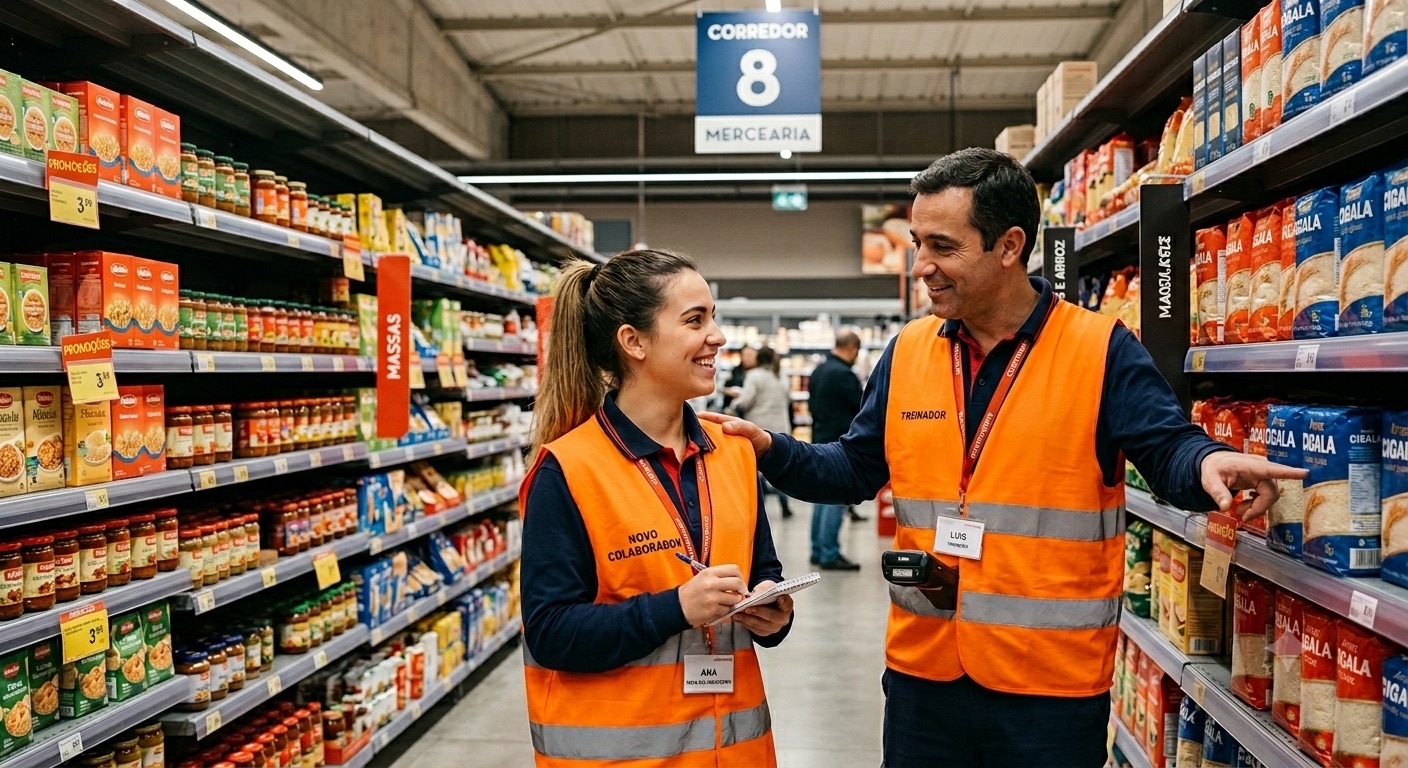
A safety instruction across a retail network
Instead of emailing a PDF to the manager, the company publishes a 90-second explanation, a three-point checklist and a simple acknowledgement. The message reaches only the relevant stores and roles. The manager uses the shift briefing to answer questions while HR follows up on views and unresolved issues.
One experience for communication, learning and listening
When communication sits in one channel, learning in another and feedback in a third, frontline employees have to learn where to search instead of receiving one coherent experience. The answer is not another app. It is one entry point where a relevant update can lead to an action, a piece of microlearning, a question or recognition.
GFoundry’s Internal Communication solution brings together a news feed, targeting, interactions, feedback and learning in a mobile-first experience, with apps for iOS and Android.
Write for the three minutes operations actually has
An effective message for deskless teams is not a shortened newsletter. It is designed for a specific decision: what changed, why it matters, what the person needs to do and where to ask for help. If the answer takes more than three minutes, divide the content into stages and make progress visible.
- Action title: state the change or task without vague wording.
- Brief context: explain the impact on safety, the customer, quality or routine.
- One step: ask for an acknowledgement, response, short read or completed task.
- Accessible help: name the person or space where questions can be raised.
This format improves learning too. Instead of concentrating critical procedures in a long session, a sequence of short content can introduce, test and validate knowledge in context. For industrial operations, that connects communication, safety and learning in the flow of work.
Turn message reception into participation
Publishing is not communicating. Deskless teams need to be able to react, ask questions, flag obstacles and recognise colleagues. That participation is the most useful reading of communication quality: not only whether a message was opened, but whether it was understood and helped people do the work better.
Strong operational communication reduces the distance between a decision and the person who will put it into practice.
Create simple cycles: the organisation communicates a change, the team confirms or asks, the manager closes the local context and the organisation shares what was adjusted from that feedback. Peer recognition can reinforce important behaviours, from safety to supporting a colleague during high-pressure moments.
In logistics and transport, people work in motion and contact with headquarters is naturally intermittent. A well-designed digital experience connects updates, goals and recognition without ignoring the reality of the route.
 Measure reach to improve, not just to report
A view rate alone does not tell you whether communication worked. Analysis should identify who was not reached, which teams need an in-person reinforcement, which topics generate the most questions and whether associated actions were completed. Start small: choose two or three measures linked to one campaign or procedure.
Reach
Compare location, role and shift to find real distribution gaps.
Understanding
Use short questions and quizzes to see whether the message was clear.
Action
Connect communication with an acknowledgement, task, learning or operational indicator.
Improvement
Close the loop and explain what changed from feedback.
The result is not another reporting layer. It is an organisation in which the person in the field has the same access to context, learning and voice as the person in the office.
Implement in stages and protect trust
A good implementation does not start by trying to digitise everything. Choose a pilot audience, such as a region, warehouse or group of stores. Define a use case everyone can recognise: a safety update, onboarding, mandatory learning or a recognition campaign. Measure whether people could access the channel, understood the message and where questions emerged.
In the second stage, turn what worked into a standard: editorial owners, targeting rules, a maximum content length and a response routine. The manager is an important ally, but should not become a bottleneck. The platform gives them context to guide the team without transferring the full responsibility for distributing, forwarding or proving that communication happened.
Finally, explain what information is measured, why and how it is handled. A mobile experience only earns adoption when it is useful, relevant and respectful. Success comes from restoring time and clarity to operations, not increasing the volume of messages.
The channel is only inclusive when it reaches the whole company
Reaching employees without email or computers is not a peripheral project. It is a decision about who participates in culture, receives learning and has a voice to improve the work. The best channel reduces access friction, delivers relevant content and makes responding as easy as reading.
Start with one concrete operational situation, prove that the team can use the channel and improve it based on their questions. From there, the same experience supports communication, learning, recognition and feedback. The company stops communicating only with people closest to a screen and builds a consistent connection with those closest to the customer, product and operation.
Do not look for perfect adoption in the first month. Look for evidence of usefulness: fewer repeated questions, faster distribution of an instruction and more people participating. When content helps solve a real shift problem, use stops relying on constant reminders and becomes part of the routine.
To explore how this approach fits your context, book a GFoundry demo.